
Warren updates ward map
Council members look to clearup confusion surrounding process
Trending
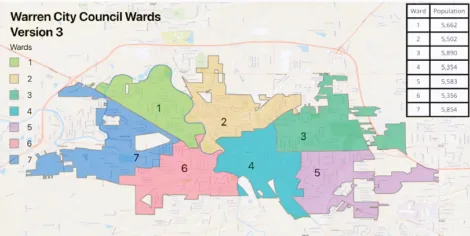
WARREN -- Longtime Warren City Councilwoman Helen Rucker said council members are happy with the redrawn lines marking the boundaries of the city's seven wards. The new map was approved at the Sept. 9 council meeting.
"Long story short, ward councilmen came to the consensus that they liked the way the (new boundary) lines are drawn, and I just decided I wouldn't buck it. We had a unanimous vote (for) it," she said.
For Rucker, D-at Large, the redrawing of ward boundary lines, which is required by law to equalize the population of each ward in the city as much as possible, raises questions. For instance, will a person's voting precinct move farther away from their home? Will the next census more accurately count everyone in Warren, including people who move a lot?
For Councilman Greg Thumm, D-at Large, who took the lead in getting the new ward boundaries redrawn with the help of the League of Women Voters of Ohio, the job was something that needed to be done to provide equal representation to all Warren residents.
"The whole exercise was really a population exercise. The only population adjustments that could be made are the border streets between one ward and another," he said.
"There was never an intention or thought or strategy that included anything but robbing Peter to pay Paul by moving a border street over from one ward to the other so population sizes were equal," he said.
"It took all these months to accomplish it because I think there is a lot of misinformation going around that shares an untrue association with federal districting," he said.
He feels the process in Warren would best be called "population equaling," rather than a term associated with federal political boundaries that is sometimes used -- redistricting.
Cleveland City Council is among entities who refer to the process as "ward redistricting," though some others call it "local redistricting" or "municipal redistricting."
Thumm said the League of Women Voters urged the city to equalize the population of the wards because it had not been done for decades.
When he was asked whether there is a process to notify the residents whose ward changed, Thumm said residents were alerted that ward meetings were being held months ago throughout the city to learn about the proposed new boundaries.
"They could ask whatever questions they wanted," he said. "We had a map that showed the (new) boundary lines," he said.
Trevor Martin, the League of Women Voters representative who worked with Warren on the project, said earlier this week that he is not aware of a way to notify the residents whose ward has changed. The city of Warren website has the old ward map on it, but not the new one.
Martin acknowledged that Warren is not the only city in the region that allowed its ward boundaries to go many years without being updated as outlined in Ohio law.
"A lot of people are aware that we redistrict every 10 years when it comes to Congress and the state districts. But a lot of folks, even those in charge, city officials, have no idea that they are supposed to do it locally every 10 years," Martin said. The League of Women Voters has found "dozens of cities that are decades behind on redistricting and didn't even know it was a responsibility of theirs."
REDRAWING LINES NOT ENFORCED
He said after each U.S. Census, the Ohio Secretary of State sends out notices to all 88 boards of elections in the state telling them the new population numbers and advising them of things they need to do.
He said the League of Women Voters recently assisted the city of Struthers with its redistricting. Their map had not been updated since 1971. He said Struthers Mayor Catherine Cercone Miller told him that the last time the city's maps were redrawn was "before I was born."
Martin noted that in Cleveland, a charter city, the number of council members was reduced by two recently because the city's charter required that to happen based on census numbers.
Martin said Ohio law requires cities to address the ward boundaries every 10 years, but it has not been enforced. He said he spoke with members of Hubbard City Council earlier this week. Hubbard had not adjusted its ward boundaries since 1966, when it became a city.
PUBLIC PARTICIPATION
Martin said Warren had six public meetings -- one in each ward except a combined Ward 1 and 7 meeting to talk to residents. The attendance was as low as five to six people and as high as a couple dozen people in wards 3 and 6.
"During those public meetings, I discussed ... why representation is important in city government," Martin said.
He said a live mapping session took place, during which residents were shown "a couple of different options" for how the wards might be redrawn. The attendees were given questionnaires to fill out on issues such as "are there neighborhoods they would like to keep together" and their feelings on polling place location changes.
He said about 56 responses were received that went into the report that went to Warren City Council, along with ward maps the League was proposing.
"The idea is to get feedback from the citizens before anything is presented or voted on. That way, we can have voters be a part of the process," Martin said.
When Stephanie Penrose, Trumbull County Board of Elections Director, was asked about the new Warren ward map, she said she received a copy of it recently, but it will not affect the November election, so she has not reviewed it yet.
She believes the new ward map will affect the primary election in the spring, but during her 11 1/2 years as board of elections director she has never had a city in Trumbull County redraw its ward boundaries.
She said the Trumbull County Board of Elections will be shifting around some polling locations for the primary election because of accessibility issues.
"Right now, very few of our locations are properly accessible," so the polling places for accessibility might "mesh" with changes in Warren's ward map, she said.
Thumm said the legislation approving Warren's new ward lines was approved after three readings at separate Warren City Council meetings to give the public the opportunity to ask questions, though he did not recall any residents coming to inquire about it.
In addition to every resident of Warren having a ward council member, all residents also are represented by three at-large council members, including him, Thumm said.
"If you're not comfortable with any of the council people who will now represent you ... (residents) can contact any council at large (member) at any time," he said.
THUMM EXPECTS WARREN POPULATION GROWTH
When asked whether there was consideration given to reducing the number of council positions in Warren from its current 10 because of the decline in the city's population over the years, Thumm said there is a population "trigger" of 40,000 to lower the number of ward council members.
"But my position and I would say the majority of people on council is that Warren's going to become a bigger city," he said. "We are under 40,000, but there has been no talk (about lowering the number of ward council members). In fact the opposite. We are under the impression that Warren is going to increase in population, not decrease."
He said development of the Kimberly-Clark factory on the south side of town and Foxconn purchasing the 6.2-million-square-foot former GM plant in Lordstown suggests that growth is coming.
Thumm said Foxconn is among the largest -- possibly the largest -- facilitators in the world. The company has not yet announced its plans for Lordstown, but it seems likely there will be "more jobs," Thumm said, adding that Foxconn companies assemble the majority of Apple products.
He said because of his 40-year career in the watch industry, in the 1990s, he and several colleagues went to a watch-case factory in China and drove "for miles on one road where every building said Foxconn on it." He said Foxconn employed 400,000 workers in one facility -- "not 40,000, 400,000 workers," Thumm said.
5TH WARD
For Warren 5th Ward Councilman Michael Shrodek, redrawing of lines was less complicated than in other wards because the 5th Ward needed fewer changes than other wards.The Fifth Ward is in the southeast area of the city.
Before the lines were redrawn, the 5th Ward had 6,114 residents, which is 514 more than the average in the city, which is 5,600 per ward.
The redrawing of council wards resulted in the 5th Ward dropping to 5,583 residents, which is 17 fewer than the average. According to Martin and documents he provided to the Tribune Chronicle, reducing the number of residents in the the 5th Ward meant moving residents from all or parts of several streets south of Youngstown Road, including Rogers, Beck, Milton, Feederle, Belvedere, Hazelwood and Clarence, to the 4th Ward.
A more dramatic example of redrawn ward lines took place just west of Perkins Park, where the 6th Ward gained several streets north of West Market Street, including parts or all of Ohio, Dickey, Austin, Haymaker, Stiles, Taylor, McMyler, Parkman, as well part of all of Mulberry, Buckeye and West Market Street until almost Mahoning Avenue in the Peninsula area.
Some of those streets were previously in the 1st Ward and some were previously in the 7th Ward.
When asked if he thinks anyone whose home was moved to a different ward will be unhappy to have a different council member, Shrodek said there can be people who are happy and people who are unhappy.
"There will be 600 people who are affected," he said.
Shrodek said he feels bad to lose any of his ward residents. "When I campaigned, I walked every street. If someone wasn't home, I went back. I think I hit all of the houses," except where they posted no-trespassing or no soliciting signs. "But not everyone answers the door, no matter how many times you go back."
He said his constituents are "people that you talk to, relate to, you listen to their problems and concerns, so it's difficult" having them moved to another ward.