
Warren native is attempting solo Arctic Ocean journey
Trending
Those who knew Matt Rutherford when he was growing up in Warren might have thought he'd only be exploring the inside of a jail cell.
Rutherford, 45, left Aasiaat, Greenland, on June 25 in an effort to be the first person to circumnavigate the Arctic Ocean on a nonstop solo journey. He's already in the Guinness Book of World Records as the first person to solo circumnavigate North and South America on a 309-day voyage in 2011 and 2012.
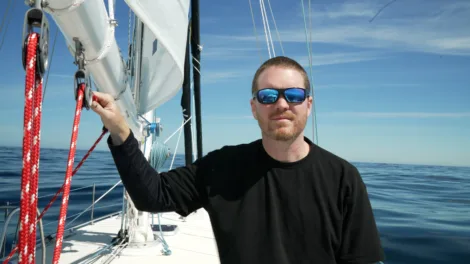
On Day 34 of his current journey, Rutherford spent an hour via Zoom talking about the reasons for the trip and his tumultuous childhood with crystal blue water and an even bluer sky as his backdrop. With access to a Starlink satellite, he was able to connect to the internet at 81 degrees north latitude.
"Today will be the day I make my furthest north," Rutherford said Wednesday. "This is one of the parts of the planet where you can get the furthest north ... You don't usually get this flat, calm condition in the open ocean. Last night, the wind died. It was like a swimming pool. The boat's just perfectly still. I'm appreciating my time up here before I turn back around and start heading for Russia."
Making it that far north in a fiberglass boat would have been unthinkable even a decade ago. The ice would have been too thick, and Rutherford's 27-foot-long sailboat is no icebreaker. The polar ice cap is shrinking, and what remains isn't as rock-solid as it once was.
"We are working our way toward ice-free summers," Rutherford said. "In the winter, it's going to freeze to -30, -40, but it's not going to be cold enough to maintain it through the summer. I don't know how long that's going to take exactly, but we will (find out) if things do not change. We'll have ice-free summers at some point, potentially in my lifetime."
Rutherford is co-director of the Annapolis, Maryland-based Ocean Research Project, which describes its multipronged mission as discovering ocean mysteries, observing humanity's impact on the oceans' health and inspiring change and public awareness.
Significant cuts in federal funding for scientific research makes paying for that work increasingly difficult, he said. ORP has learned that record-setting expeditions oftentimes can get more media attention and public awareness than research papers.
The public can track Rutherford's journey at oceanresearchproject.org, where they also can donate to the organization's research efforts. And he posts weekly video updates on ORP's YouTube channel (youtube.com/@oceanresearchproject).
Rutherford said they would like to raise enough money to purchase a new engine for ORP's research vessel, but these journeys also feed Rutherford's craving for adventure, which didn't manifest itself in such positive ways when he was younger.
Rutherford grew up in Warren and said his parents first came to the area because they were part of a cult, originally known as Truth Fellowship and then simply the Group.
"It sounded less culty," Rutherford said.
It wasn't a commune, but followers would buy houses in the same neighborhood and were only allowed to be friends with other members. They were told what kind of car to drive, even the wallpaper pattern to use in their homes.
"I'm sure it contributed at some level to all the trouble that I got into in my teenage years," Rutherford said. "I had to get locked up five times by the age of 16. I grew up in institutions, juvenile detention centers. I was on probation from 14 to 18. That was my 18th birthday present -- when I got off probation, which is a great birthday present. Probation sucks."
He bounced around northeast Ohio, staying in Kent, Akron and Cleveland and continuing to live what he described as a "street lifestyle," using and selling drugs.
"The streets are an adventure, but they're an unhealthy adventure," he said. "I didn't know at the time that I needed that adventure in my life, and that was partly what was drawing me to this, that and probably a lack of self worth. I think a lot of criminals don't realize it, but if you have a lack of self worth, you don't care. If you don't love yourself, how can you love anybody else?
"As you get older and you've been locked up enough and you're watching your friends getting locked up as adults and some are dying, I started to look for other ways that I can have adventure, although I don't know if I was really that aware that I was doing it at the time. I think it took me another five years or so of just being away from that street environment before I realized all this stuff. Spending 309 days alone in the ocean helped."
As a teenager, Rutherford read a book about British explorer Ernest Shackleton (1874-1922), who led three expeditions to Antarctica, which started his fascination with explorers and sailing. He moved to Maryland at age 25 and bought his first boat for about $2,000. Not able to afford both a boat and an apartment, he lived on the boat.
"If you live on the boat, you can get a slip in a marina that allows you to live aboard, and it's cheaper than having your own apartment," he said.
He upgraded to a second boat that cost about twice as much and then bought a 32-foot boat with a diesel engine instead of an outboard and enough head room that he could stand up straight in it. That was the boat he used for his first two voyages across the Atlantic.
Warren remained his driver's license address until his mid-30s. He would go on expeditions to Greenland and make money by sailing other boat owners' crafts to new locations, so he seldom was in Annapolis for more than a couple of months at any time.
"You can't put 'ocean' on your driver's license," Rutherford said. "They don't accept that."
The record-setting journey around the Americas attracted international attention and made him the subject of the documentary "Red Dot on the Ocean." But following in Shackleton's footsteps had been a dream for nearly 30 years.
"I just didn't know how I'd ever be able to do it or go there," he said. "It seemed impossible for a long time. It just seemed so far away. In 2008, in my late 20s, I sailed from Annapolis to Europe, which was like my first big trip alone. The whole time I'm talking about sailing to the Arctic. I was sailing toward Africa, and I was always talking about sailing to the Northwest Passage ... About a year after I got back from that, I did a trip around the Americas and actually went up and did the Northwest Passage, which is a place with a lot of lore and history and, unfortunately, a lot of casualties. But it seemed like sort of an ultimate challenge too, and I like a good challenge, obviously."
The challenges are magnified on a solo journey. The calm water and blue sky on Wednesday was an exception, not the norm. For much of the journey, Rutherford needs to be on watch for floating ice that can cause irreparable damage to his boat. And as the only one aboard, there's no one to tell, "Keep an eye out while I get a few hours sleep."
Sleep deprivation is one of the biggest obstacles, Rutherford said. He's learned to survive on short stretches of an hour or less of sleep and sometimes can slip into deep REM sleep in a 15-minute nap.
He's eating mostly freeze-dried food, and individual ingredients rather than prepared meals. He admitted he hasn't done a great job of pacing himself for a trip that isn't projected to end until the beginning of October.
"I ate my chocolate too fast. I ate my macadamias too fast. I ate my beef jerky too fast," Rutherford said.
But the magical moments outweigh the difficult ones, and that's what he embraces.
"The iceberg you're looking at right now might not look that way in a day or two," he said. "No two are identical. I think the best thing to do is just try to have a positive attitude. Why in the world would you be doing something like this if you didn't enjoy it? If you're miserable, then this would just suck. You've got to come at it like you're a kid at Disney World and deal with the hardships as they come. Being negative or being miserable is not gonna give you a hot shower and a piece of pizza and cold beer, right? It's not gonna change anything. All it's gonna do is make it miserable."