
Town hall focuses on rising costs
Trending
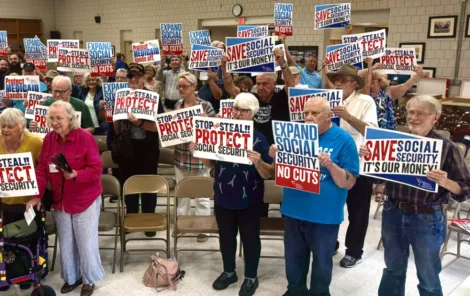
LORDSTOWN -- Everything was working like a well-oiled machine when Samm Lewis moved into her unit designed for those of middle income, but after the COVID-19 crisis, not so much.
"Services have disappeared, and the carpets are threadbare," Lewis, 74, of Warren, said about conditions at the 55-and-older housing community in which she has lived since 1996.
Compounding the problem is that her heating and cooling system has failed, among other things, yet she is facing a $145-per-month rent increase, bringing her monthly payments to $800, Lewis told more than 100 union members and others who attended a public town hall meeting Friday afternoon at the United Auto Workers Local 1112 union hall, 11471 Reuther Drive.
Hosting the two-hour session was the Mahoning Valley People's Action Alliance, in conjunction with UAW Local 1112, the Ohio Alliance for Retired Americans and the United Steelworkers Organization of Active Retirees.
Serving as facilitator was Norm Wernet, the Ohio Alliance for Retired Americans' president.
The primary themes were protecting and preserving Social Security, Medicare and Medicaid, along with the effects of rising healthcare, utility and other costs. Also discussed were what many see as the devastating consequences of area hospitals closing and collapsing.
In addition, Friday marked the 91st anniversary of when President Franklin D. Roosevelt signed the Social Security Act into law Aug. 14, 1935.
For years after Lewis moved into her unit, residents enjoyed a strong sense of community and looked after one another. Now, however, the complex is refusing to rent to new tenants for about two years, creating a number of vacancies, she said.
"This is unconscionable," Lewis added.
Dot Fulmer of Youngstown, a 62-year-old widow who is four years from being eligible to receive Medicare, said she continues to navigate the challenges associated with increasing Affordable Care Act premiums and deductibles, along with medical debt.
Specifically, Fulmer needed two surgeries related to a car accident. She said she expected to incur some out-of-pocket expenses, but her premium is five times higher than it was last year, and she has to pay 30% for surgical tests, whereas before, she was paying a 20% deductible, making it so she can't afford to undergo the second surgery, Fulmer said.
Janet Cobb of the Mahoning Valley Freedom Fighters organization told the audience that for years, she had received a housing subsidy from the U.S. Department of Housing and Urban Development, but because of certain changes, she was getting the subsidy through a mental health clinic, for which she was required to fill out reams of added paperwork.
Exacerbating the problem was learning about a decrease in grants designed to prevent homelessness and keep people off the streets, Cobb explained, adding that her monthly rent payments jumped from $449 to $649.
Cobb expressed gratitude that she has received help from others and is doing quite well, but reserved her concern for those in similar situations who have less assistance and fewer resources.
"What about the people who aren't me?" she said.
HOSPITAL CLOSURES
Discussing the human cost of a local hospital's demise was Thomas Connelly, president of the American Federation of State, County and Municipal Employees Local 2026, which represented nurses at Trumbull Regional Medical Center in Warren.
In the early 20th century, many sick people in the area had nowhere to go, so charitable organizations collaborated to take care of them and collect funds to build what became Trumbull Memorial Hospital. Over time, the facility became a 300-bed hospital and offered full outpatient services, Connelly said in his remarks.
Eventually, however, the healthcare system developed a tremendous imbalance, resulting in Medicare and Medicaid reimbursements being a fraction of the cost of caring for patients. As a result, TMH and other hospitals began to get into financial trouble, leading them to cut programs and services, and having for-profit private-equity companies that have no vested interest in, or care about, the community, manage them, Connelly noted.
Forum Health, Steward Health Care and, most recently, Michigan-based Insight Health System managed the shuttered Insight Hospital at Trumbull in Warren, formerly Trumbull Regional Medical Center. Earlier this month, Dayne Walling, an Insight Health representative, told Trumbull County Commissioner Rick Hernandez that hospital officials are working to reopen the facility.
At one point, an Insight Trumbull spokesperson announced that hospital operations were suspended, with no new patients being admitted. Shortly before the announcement, the Ohio Department of Health cited heating problems and failure to provide appropriate care to patients.
In October 2025, the department barred the hospital from reopening. About a week later, however, the facility did reopen, but in late January, the hospital had to surrender its license to operate at the ODH's request, and has been closed since.
As a result, St. Joseph Warren Hospital is the county's primary healthcare and emergency services provider.
"We don't have enough hospitals in this area," Connelly said, adding that also lacking are an adequate number of hospital beds, doctors and nurses.
Too often, out-of-state entities "chop us up and move out of town," he continued.
Also, a hospital closure is far from being an isolated event. It creates a negative local economic ripple effect, contributes to many people being unable to afford to keep doctor's appointments and often contributes to blight, Connelly said.
"People are afraid of getting sick in this country, and they should be," he added.
Dr. Janet Shiley, a retired general surgeon, said that a variety of healthcare "deserts" exist locally and nationally. Shiley, who also worked 20 years in private practice, defined such a "desert" as a lack of access to timely and affordable care, along with clinic closures and too few doctors and nurses in a given region. Other factors are population declines and economic disparities – all of which often lead to delayed diagnoses and treatment that create increased risks of obtaining preventable diseases, and death, Shiley noted.
The seasoned healthcare provider also cited the Hill Burton Act of 1946, which gave hospitals, nursing homes and other care facilities loans and grants for construction and facility modernizations in return for them to agree to offer a reasonable amount of services to those unable to pay, and to make their offerings available to all people in the facility's area.
Since 1980, more than $6 billion in uncompensated services has been provided to eligible patients via the act, according to the Health Resources & Services Administration.
Today, too many elected officials are intentionally "tampering" with Social Security, a system that should continue to be funded and does not contribute to the national debt, Wernet said.
"Social Security is something we built for ourselves," he added.
Adding to the problem is that many millionaires and billionaires are interested only in building their wealth, Wernet said. He also noted that a provision in the One Big Beautiful Bill Act bars the prices of certain drugs such as Keytruda, for example, from being negotiated.
Keytruda is a prescription immunotherapy medication used to treat several kinds of cancer.
TAKING ACTION
Also at the session, an action plan was discussed that included calling at least one elected official within 48 hours, emailing one's story and asking for a written reply, attending future town hall meetings and voting in the Nov. 3 midterm election for those who represent their interests, as well as asking Congress to pass the Older Americans Act Reauthorization Act, restore enhanced ACA premiums and tax credits, protect Medicare, Medicaid, housing and utility protections from cuts, and strengthen Social Security via having wealthy Americans contribute to it more often than one month per year.
The next town hall session," The State of Valley Healthcare," is set for 2 p.m. Sept. 26 at the International Union of Electrical Workers-Communications Workers of America Local 717 union hall, 2950 Sferra Ave. NW, Warren. Doors open at 1 p.m.