
Our Heritage: Leavittsburg thrived during the canal and railroad eras
Trending
EDITOR'S NOTE: This is part of a weekly series on our region's history coordinated by the Trumbull County Historical Society.
Located on the banks of the Mahoning River, Leavittsburg was founded in 1803 by John Leavitt of Suffield, Connecticut.
Leavittsburg was a candidate at one time to be the county seat, but with population growth, Warren supplanted Leavittsburg and became the permanent county seat.
From 1839 to the 1850s, Leavittsburg became a canal town with the construction of the 82-mile Pennsylvania and Ohio Canal that ran through the center of town. Thanks to the canal, early industry developed along the riverbanks, with one of those being the Leavittsburg Feed Mill used water power generated by a wooden and earth dam that was recently exposed with the destruction of the 1909 dam.
With the wooden dam being exposed, the original water wheel for the feed mill was found and can today be seen at the Leavittsburg Heritage Museum property.
In the mid-1800s, the railroad bought out the canal property and laid steel tracks, putting Leavittsburg on the map as a railroad town.
With the converging of lines of several railroads, Leavittsburg became a massive railroad terminal. At its peak, 40 trains per day, including passenger trains, would come through. The various railroads used different track gauges, so trains were forced to stop in Leavittsburg to switch tracks.
To accommodate overnight travelers, local landmarks such as the historic Allen House hotel flourished. By the mid-20th century, the local station connected passengers to destinations like Boston, Orlando and San Francisco.
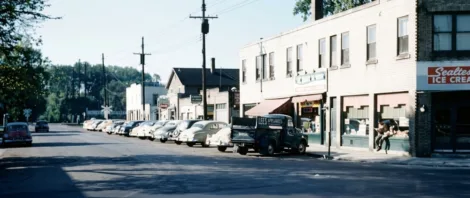
In the peak of the railroad existence of the 1940s to 1950s, Leavittsburg had several neighborhood businesses and markets that became the social and economic hubs of the community, long before giant supermarket plazas took over.
Bucy's was located on a corner near the railroad tracks. It originally stood as a two-story building before being torn down and replaced with an updated single-story storefront. It was a beloved neighborhood staple.
Thornhill's Market was a local market deeply embedded in Leavittsburg's history. Like Bucy’s, it represented the era of independent merchant grocers that defined the town's commerce along the Mahoning River.
Vingle's Market and Restaurant served as both a grocery and a sit-down community diner.
Risher Dairy was an early version of a convenience store where students spent time together after school.
Milon Dry Cleaners, where men from the Ravenna Arsenal would come to have their uniforms cleaned and pressed, was located just past the railroad tracks and a short walk from Bucy's.
Seck's Drugstore was the go-to neighborhood pharmacy and a community gathering point.
Leavittsburg Hardware, before big-box home improvement chains arrived, supplied tools, farming equipment and building materials for the residents. These small, personalized shops were places where the owners knew every customer by name, often keeping running tabs for neighborhood families.
And finally, Leavittsburg had three taverns: The Hillside Club (a private club), the Bottle and Cork and The Wagon Wheel, which is still in business today.
As long-distance passenger trains declined in the 1960s and 1970s, the local yards -- then operated by the Erie Lackawanna Railroad -- fell silent. The tracks were eventually abandoned, and the town transitioned into a quieter residential community.
Today, the Leavittsburg Heritage Association actively maintains local artifacts and records out of the Leavittsburg Heritage Museum, preserving the memory of the town that helped put Northeast Ohio on the map.