
Firefighter doesn’t let kidney failure keep him from dream
Trending
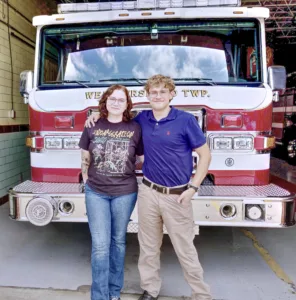
WEATHERSFIELD -- Evan Warholic doesn't like to ask for help nearly as much as he likes giving it.
The 24-year-old, who juggles three part-time jobs and wants to be a paramedic, is in end-stage renal failure and isn't comfortable when the attention turns to him.
"You can kick and scream all you want, babe, we're getting you a kidney," his girlfriend, Madison Herbert, joked.
The two sat down recently to talk about Warholic's medical journey, his career and their plans for the future.
Warholic has Alport Syndrome, a genetic disorder that damages tiny blood vessels in the kidneys, causing progressive disease that often leads to hearing loss and vision changes.
He is also considered deaf and wears hearing aids in both ears after experiencing what he calls "profound hearing loss" as a kid. He does dialysis at home every other night. Warholic, who grew up in Ravenna, is a part-time firefighter in Girard and Warren Township, a volunteer firefighter at Weathersfield Township Fire Station #40 and works for Physicians Ambulance station 5 in Warren.
That's where he met Herbert, who is on medical leave after tearing her ACL in February while fighting a structure fire.
The two said they hit it off pretty quickly and began dating, with Herbert saying she knew of his condition but had no hesitation.
"I couldn't imagine not dating someone because they have a medical condition," she said, adding she would have donated a kidney had they been a match.
She's had her own health issues, including emergency surgery last year to remove her gallbladder and another to remove possible cervical cancer in January.
The two plan to marry eventually and have talked quite a bit about adopting in the future, as both have genetic conditions they don't want to pass on to their children.
The focus for now, however, is to find a house that works best for them. Herbert said having a third-story apartment now isn't ideal, given their current physical limitations.
Warholic is also studying at Trumbull Career & Technical Center to become a paramedic, saying he took an interest in the medical field after watching his mom, a trauma nurse, in action.
Warholic receives peritoneal dialysis at home instead of hemodialysis in a hospital, which he said is convenient.
If he does find a kidney, he said he'll have three of the organs, as doctors won't remove one unless it develops cancer, because removing one presents a bleeding risk.
Because he's considered to be in the end stages of kidney disease, Warholic said he would qualify for disability but that not working "would destroy my life."
He said he doesn't know what he'll do if it comes to that because "I do like helping people and it's a very fulfilling job."
To get the word out, the family has held a benefit dinner in the past and hopes to plan another soon.
There is no cure or treatment that can eliminate Warholic's condition.
"You can't fix this without a transplant," Herbert said.
Warholic said his parents noticed blood in his urine a few times when they changed his diaper as a baby and suspected something was wrong.
He was originally diagnosed with an autoimmune condition, but hearing loss prompted doctors to do a kidney biopsy, which showed he had Alport Syndrome.
He said he had a pretty normal childhood, riding dirtbikes and, eventually, motorcycles when he was older.
"Even now, I'm still pretty active," he added.
Warholic was listed in early 2024 and said the wait for a deceased donor is typically three to five years.
Quite a few people in Warholic's life -- including Herbert, his mother and other relatives -- have been ruled out as donors because of incompatibility.
Warholic has no family history of the disease, though his mother had breast cancer twice, his maternal grandmother had it once and his father has Multiple Sclerosis.
He has to be careful what he eats, as anything too high in potassium or phosphorus can affect his kidneys.
He tracks his intake carefully and said dieticians and nutritionists are part of his care team.
Atul Agnihotri, CEO of Kidneys for Communities, is helping Warholic find a donor and coordinate a transplant.
According to the organization's website, chronic kidney disease affects about 37 million U.S. adults and over 750,000 of those have end-stage renal disease.
Altruistic donations, or those between strangers, make up only 3% of the annual living donor pool of transplanted kidneys in the U.S., the website says.
Agnihotri, who lives in Toledo, was in his 40s, working for a Fortune 500 company and traveling the world when he found out he was in kidney failure.
He had no symptoms, was in good health and found out his kidneys were functioning at 10% when he and his wife applied for additional health insurance.
A coworker's family member donated a kidney and Agnihotri went back to work, but ultimately left his job when he realized he was called to do more.
"My nature is to work," he said. "My nature is to act."
Transplant centers are very conservative about donors, Agnihotri said, adding there are health and lifestyle criteria donors have to meet.
Living donors provide the best outcomes, he said, and a kidney from a living donor tends to last twice as long as a kidney from a deceased donor.
Most donors go on to live healthy lives with one kidney, Agnihotri said, adding that his father donated a kidney to his sister when she was a teen and went on to live into his 90s without complication.
The organization uses a paired kidney exchange program that offers a kind of "pay it forward" model.
If a person wants to donate a kidney to another but is incompatible due to blood type or antibodies, he or she may still be able to donate through paired kidney exchange, Agnihotri said.
This innovative program is offered through most transplant centers in the U.S., he explained.
With this type of paired kidney exchange, the donor can give a kidney to another patient who is compatible, while the original patient gets a kidney from another donor.
Agnihotri said, "these exchanges can involve two incompatible patient-donor pairs or extend to three-way, four-way or even longer chains, helping more patients receive compatible living-donor kidneys."
Agnihotri said Warholic's story is being shared widely across first responder and other communities and he's confident someone will step up to save the firefighter's life, the same way he shows up every day to save others.
"Goodness will come his way," Agnihotri said. "I'm 100% sure of that."
For more information, visit https://kidneysforcommunities.org/recipient/evan-warholic.