
Dressing for the Revolution
America250 talk covers fashion, Ohio’s role in war
Trending
WARREN -- Although Ohio didn't become a state until 1803, the area participated in the Revolutionary War.
That fact was among many presented Tuesday in a program for children ages 8 to 12 at the Warren-Trumbull County Public Library that was presented by the Trumbull County Historical Society in conjunction with America250.
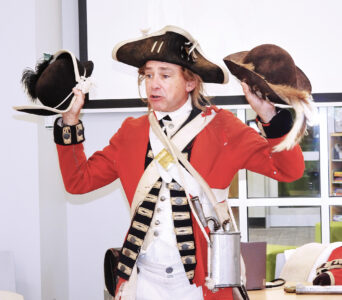
Doug Pfouts, dressed as a British soldier from the King's Eighth Regiment, told the children and adult attendees about his clothing, headgear, supplies and conditions during the war.
After asking if any of the youth knew about the Buckeye State's involvement with the United States breaking away from Great Britain and its monarchy, Pfouts then pointed out the exact location.
"It took place in Bolivar, Ohio at Fort Laurens," he said, which is approximately 66 miles southeast of Warren. Pfouts is a member of the Friends of Fort Laurens Foundation.
"The fort was built in November and December of 1778," Pfouts said.
The Declaration of Independence was signed in 1776, two years before the fort was built. Armed conflict began in 1775 and ended in 1783 with the signing of the Treaty of Paris.
Pfouts explained that soldiers from Fort Pitt in Pittsburgh crossed into Ohio to build the Continental Army fort for the future Americans.
"In the summer before coming to Ohio, they built Fort McIntosh in Beaver, Pennsylvania," he said.
In early November 1778, 1,000 soldiers, 1,200 pack horses and men taking care of the horses left Fort McIntosh for Ohio to build Fort Laurens.
"When they started out, it was 15 degrees. They had snow storms. They had rain. They had 50 degrees. They had weather all over the place," said Pfouts of the 15 days it took them to travel to their destination.
Despite fighting the elements, they built the fort in 10 days.
"The main troops went back to Fort Pitt and Fort McIntosh. They left 150 men and five women behind," Pfouts said.
When Pfouts asked the children what the women did at the fort, Rosie Fuhry, 8, of Vienna, replied, "They helped the soldiers cook and clean and got water for them." Pfouts added that the women also took care of the sick and mended the soldiers' clothing.
The fort was made of wood logs 20 feet high. It covered approximately an acre.
The British were in Detroit and the fort was built to protect the western portion of the country, Pfouts said.
He discussed soldiers who gathered wood for the fort and were attacked by the King's Eighth Regiment and Native Americans.
"They attacked the wood party. There were 17 men and 15 were killed. Two were captured to bring back to Detroit."
He explained that one of the captives lived with the Native Americans in the Detroit area until he escaped around the end of the war. That soldier wrote about his experience, offering a first person historical document for future generations.
Pfouts discussed the conditions when the Native Americans surrounded the fort for a month.
"They couldn't get out to get the essentials that they needed to survive. A couple of them snuck out at night and got one deer. They boiled their moccasins and drank the broth they made. They had to wait for a relief party. Their closest friends were 75 miles away," he said.
From wool socks to his trousers, vest and jacket, Pfouts explained parts of the uniform he wore.
"There was no elastic, so clothes overlapped or had buttons or ties to stay in place," he said.
The British were known as the red coats because of their jackets. The musicians who traveled with the regiments wore blue to be seen by the commander. The Continental Army soldiers and musicians wore the opposite colors from the British.
He also showed three different hats that a soldier would wear.
"The brown hat had to have a deer's tail on it. If it did not, then they knew it was the enemy and they would shoot them," Pfouts said.
After his talk, the children tried on the various items of clothing similar to what the soldiers had worn during the Revolutionary War.
Pfouts encouraged them to visit the Fort Laurens Museum.
"When you go to this museum, remember those men that gave their lives to give you what you have today, and gave you the country that we have today that gives you the freedom you have to be able to live the lives that you have," he said.