
Army veteran witnessed end of Cold War
Trending
WARREN -- The Berlin Wall, a physical symbol of the Cold War, fell on Nov. 9, 1989, when East Germany opened its border crossings.
More than 200,000 U.S. military personnel were stationed in West Germany and one of those soldiers was Blair Carmichael, who was born in Fulton, Missouri.
He enlisted in the Army later than most at the age of 25 in 1988 after parting ways with his fiancee at the time.
"I had a relationship that went south and broke off the engagement," Carmichael, 63, said. "So, I'm like, 'OK, since I'm not doing that, I'll join the Army.' I always wanted to join the Army, but now I had a better reason to because I really didn't have much direction after that."
After enlisting, Carmichael received orders to report to Fort Knox, Kentucky, where he completed One Station Unit Training as a 19D cavalry scout, a combat-arms specialty focused on reconnaissance and security operations.
"I was a 19D cavalry scout, which is a reconnaissance (military occupational specialty)," Carmichael said. "They trained us on everything from small-tracked vehicles to trucks to Bradley (fighting vehicles), which was what I eventually started working on when I was in Germany."
Carmichael was assigned to the 1st Battalion, 69th Armor Regiment, in West Germany to act as a first line of defense in case war broke out with the Soviet Union.
"We were kind of a front-line battalion, where if the Russians were to come over the border from East Germany into West Germany, we were there to slow them down," Carmichael said. "We were the first buffer."
When the Berlin Wall came down and tensions cooled, Carmichael and other American soldiers visited areas around the West-East German border that previously had been restricted. During a 1990 visit, Carmichael met Soviet soldiers, some of whom he recalled were preparing to leave East Germany.
"This was in the next year, that spring of (1990) when we were able to go over and look at the Russian posts that were there, and East Germany," Carmichael said.
He was not the first member of his family to join the military, with both his father and mother in the service during World War II.
"My father was in the cavalry in World War II. He joined up right before D-Day," Carmichael said. "My mother was in the Navy. She was a nurse in the Navy, and then she became a laboratory technician at a hospital in Rhode Island."
Carmichael's father was in Germany at the end of World War II, and the start of the Cold War when the country was divided between East and West. Carmichael thought this was poetic because he was in Germany to see the end of the Cold War.
"My father was in World War II, and he met the Russians at the end of the war," Carmichael said. "Then I got to say goodbye to them at the end of the Cold War."
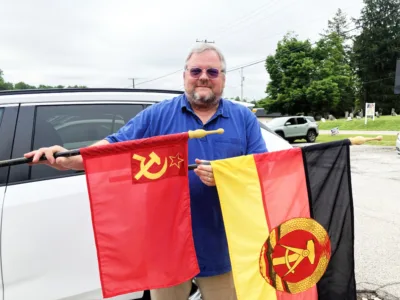
Carmichael was able to collect some Soviet and East German memorabilia before heading back to the United States, and donated much of it to the National Churchill Museum in Fulton, Missouri
"We have the Winston Churchill Museum, and I donated this flag and a couple of items to the museum because they had a whole thing on the Cold War starting, and how Churchill identified the issue and what was going on with Eastern Europe," Carmichael said. "It was nice to be able to kind of tie it up."
Carmichael works at Case Western Reserve University in Cleveland, assisting the school's faculty with digital learning.
"My wife is from Warren, and we moved back to help take care of her parents. I started working at Case Western Reserve University in 2020," Carmichael said.
Carmichael also serves as secretary for the Mahoning Valley Chapter of the Sons of the American Revolution, a nonprofit patriotic organization.
Blair Carmichael
AGE: 63
RESIDENCE: Warren
SERVICE BRANCH: U.S. Army
MILITARY HONORS: Two Army Commendation Medals for the Bradley IFV, Army Good Conduct Medal
OCCUPATION: Instructional designer/technologist at Case Western Reserve University
FAMILY: Wife, Beth