
Trending
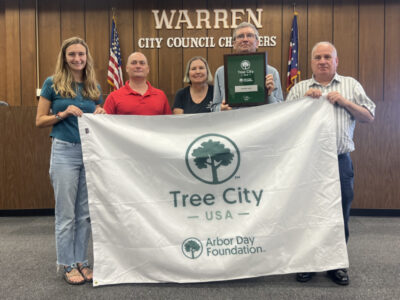
WARREN -- The Warren Arbor Commission on Thursday celebrated the city's first Tree City USA designation and opened the floor for public questions about tree maintenance, planting and responsibilities in an effort to boost residents' education and clarify city policies.
The meeting in City Council chambers drew a small crowd, along with commission members and council representatives. Officials used the session to highlight recent achievements while council members suggested some of their residents' frustrations over hazardous trees, planting decisions and maintenance costs.
Lydia Lynch, Health and Wellness Coordinator for the Trumbull Neighborhood Partnership and an Arbor Commission member, acknowledged the milestone during the gathering.
"We were one of three cities in our region of Northeast Ohio that got the designation for the first time this year, which is really exciting," Lynch said. "It was also inspiring to see some of these cities with 50 year long awards. Year one is an incredible achievement."
She explained the requirements met for the award were to celebrate Arbor Day, spending at least $2 per capita on tree-related work, maintaining an arbor commission and having relevant tree legislation on the books.
Warren is also the first municipality in the county to earn the recognition.
Councilman Michael Shrodek, D-4th Ward, who chairs the commission, opened the meeting by thanking members for their efforts to rebuild the city's tree canopy.
"I didn't realize how much work that they did until I helped on a couple of ventures, and they do a great job," Shrodek said.
He discussed trees' environmental benefits, including carbon absorption, oxygen production and flood control.
Much of the discussion at the meeting focused on practical challenges.
Resident Janet Hazlette raised concerns about homeowners' reluctance to plant or maintain trees because of high costs for trimming and potential liability from falling limbs, especially during windy conditions.
She suggested possible city-facilitated programs, similar to sidewalk repairs, to help residents.
Lynch acknowledged the issue and drew back to past city bidding for tree work before an an issue of limited funding.
"It gets to a point where, because there wasn't proper maintenance, then we're having to reactively take down all these trees that could have been saved," Councilwoman Tina Milner, D-2nd Ward said.
Milner said her constituents had voiced concerns about planting new trees while many older ones are dead or dying and about trees placed in vacant lots in ways that could hinder future development.
She cited national guidelines on removing hazardous public trees and highlighted risks to elderly and disabled residents.
Lynch clarified the commission's advisory role and distinguished between her work with planting initiatives and city responsibilities.
She said Engineering Department staff maintain a list of hazardous trees, with some removals funded in recent years, with about 140 addressed so far, but a significant backlog remains.
The commission acts as "an extra set of eyes" for the city.
Councilwoman Honeya Price, D-6th Ward, thanked the commission for work in her ward and stressed the need for education.
"A lot of people call me, they think that I'm supposed to trim the trees," Price said.
She added that clarification is needed on property owner versus city responsibilities for trees in the tree lawn (the area between sidewalk and street).
Shrodek and others noted outdated 1998-era ordinances and plans to update legislation, including species recommendations and clearer guidelines for tree lawns of varying widths. The commission also will be working toward developing a formal Urban Forestry Management Plan.