
Science informs creativity at Camp Invention
Trending
LEAVITTSBURG -- Children learning to use science and other skills to solve mysteries had the assistance of movable capybaras that they could use to solve problems at a week-long science-themed camp.
Stephanie Walton is a kindergarten teacher for LaBrae Local Schools and director of Camp Invention, which is a STEM-based program with the theme "Spark."
She said 74 students in grades kindergarten to sixth grade could attend four different modules, including "Space Morphers" to make a planet like Earth; "The Infringers" has children solving community problems by creating inventions and learning about trademarks; "Make Waves" has them creating a new product and having a patent and advertising on billboards; and "Forensics" has them trying to solve a mystery at a crime scene using robotic capybaras to help them.
Four teachers serve as instructors for the different modules.
Walton said the five-day program is designed for the children to have fun.
"When looking for camps in our area like this, there are not a lot. I love the children being able to come to a camp and be creative. When children have attended in past years, their parents tell me they continue inventing all summer long," Walton said.
Assisting the students are seventh grader Quinn Brisco and eighth grader Olivia Gee, former summer camp members, who now help students use hot-glue guns and other materials for the projects.
"We help them with their projects.They have good ideas," Gee said.
Walton said in addition to LaBrae students, there are children from Champion, Lakeview, Southington and Warren.
CAPYBARAS
Small brown capybaras were on desks and tables in one classroom.
The miniature versions that moved look like the large rodents from South America.
Joe Slifka, who teaches the forensics class, said he has the children look for clues and use DNA evidence as they try to solve a crime.
"We have swabbed the inside of some eggs to look for DNA, which we looked at under a blacklight. We found out whose DNA was on the eggs. We found feathers and fur and had to figure out who the culprit was from a list of suspects," he said.
Slifka said someone had placed onions and other sticky items in the place where the capybaras would relax.
Walton said funding for the program came from the National Inventors Hall of Fame, which covered costs for materials and staff.
Instructor Sophia D'Alesio, a first-grade teacher, said "Make Waves" focuses on inventions and the National Hall of Fame inventors.
"The students learn about creating ideas and how to protect them with patents and how they faced challenges when inventing," D'Alesio said.
She said students did sketches of their ideas and then made prototypes.
"This camp gives children a chance to deep dive into their creativity and imagination. I want them to have fun and learn about future careers and the steps it takes to create things," D'Alesio said.
Anna Belle Carnahan, a LaBrae sixth grader, said this is the fourth summer she has been at the camp.
"I like the teamwork and getting to create little machines to solve problems. There is a lot of hands-on learning, which I like," Carnahan said.
Isaac Bennett, a LaBrae sixth grader, said this is his fifth year attending the camp.
"I like that every year has been fun and being creative with what we design and make. I like learning about the different processes of creating something and patenting what you create," Bennett said.
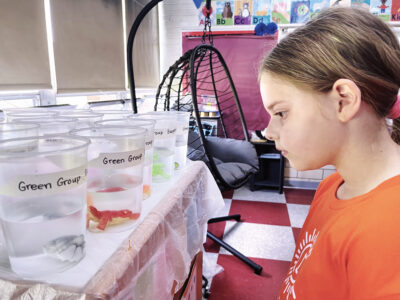
In one classroom, students were given plastic eggs that had no identification on them but when hatched under special lighting, they were frogs, turtles and other wildlife.