Author drives talk on GM Lordstown
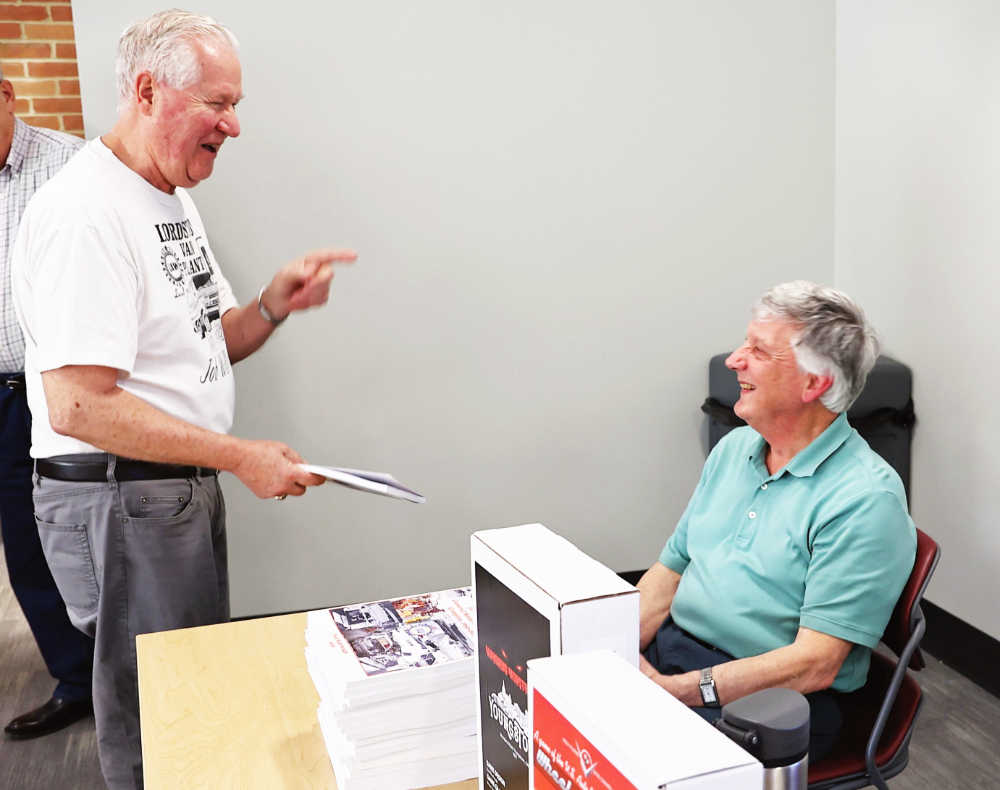
Correspondent photo / John Patrick Gatta Eugene Haggerty of Warren (left), who worked at GM Lordstown for 32 1/2 years, discusses the assembly plant with author Paul Rohrbaugh of New Middletown. Rohrbaugh gave a PowerPoint presentation based on his book “Driving It Home: GM’s Lordstown Complex 1956-2019” on Saturday at the Warren-Trumbull County Public Library’s Harding Room. He chronicled the assembly plant’s history from its inception in early 1956 to its closure in March 2019.
From bolstering the Mahoning Valley’s prosperity for more than 50 years to closing its doors and creating economic hardship for the area, author Paul Rohrbaugh chronicled the turbulent history of the GM Lordstown complex during a lecture Saturday afternoon in the Warren-Trumbull County Public Library’s Harding Room.
Speaking in front of a near capacity audience that included former workers for the automaker, Rohrbaugh gave a PowerPoint presentation based on his recently released book, “Driving It Home: GM’s Lordstown Complex 1956-2019.”
He presented a history of the assembly plant from its announcement on March 19, 1956, to its first car off the line — a white Impala sport sedan — on April 28, 1966, which was purchased by “Tribune Chronicle” owner Helen Hart Hurlbert, union run-ins with management, 23 different vehicle models produced over its existence, foreign competition, the company’s bankruptcy filing and finally its closure in March 6, 2019.
Also discussed were the attempts to revive the compound through other manufacturing ventures.
Today, the site is on the forefront of the AI revolution as part of the Stargate Project, owned by SoftBank, OpenAI and Oracle Corp.
“I’m a big historian of World War II, Vietnam and military history,” he said, “and I’m seeing all the World War II veterans disappear. They’re all gone, and I’m seeing the Vietnam veterans, the people who worked at Lordstown leaving. I had to get their stories.
“I’m so proud to have been able to interview so many Lordstown workers. Mostly, I’m very grateful for the opportunity to be able to tell of what happened there and, hopefully, some will be able to make some more history there, too.”
Rohrbaugh who turned to writing after 21 years working at Youngstown State University including teaching in the Educational Foundations, Research, Technology and Leadership department.
Upon his retirement, he wrote the GM Lordstown book as well as “Favorite Son: The Life and Times of President William McKinley.”
He plans to publish another book in June on the National McKinley Birthplace Memorial in Niles.
“A lot of people are going to ask me why I wanted to write this book. I love local history, and this is a huge hole (in local history).”
In 1964, GM bought a 1,100-acre cornfield and broke ground to build a new 2.7 million square foot facility that consisted of assembly, van and fabrication with its own natural gas power plant and nearly 477 wells.
Overall, the complex produced over 16 million vehicles including the Cobalt, Cavalier, Vega, Sunbird, Sunfire, Firebird, Buick Skylark and various vans.
The Cruze was the final vehicle manufactured there.
Rohrbaugh brought up how the local vehicle complex’s union workers fought with and had to prove to management that it shouldn’t be closed.
When the company’s executives decided to concentrate on SUVs rather than compact cars and restructured in order to cut costs, GM Lordstown became a victim of the times.
“The last Cruze that rolled off the assembly line, the color choice was intentional. The first car to come off the line was white. The last one was white.”
He brought up that Congressman Tim Ryan compared the situation to Black Monday, the infamous day that the area’s steel industry was devastated with sudden closings.
Based on a study conducted by Cleveland State University’s Center for Economic Development prior to the closing, it estimated more than 7,700 people would cumulatively lose their jobs. The economic impact was estimated to exceed $8 billion while collective incomes from those individuals exceeded $1.6 billion, which accounted for more than 10% of the Youngstown region’s gross regional product.
“The United Way still has not recovered from the loss. The workers there gave almost two million dollars a year to the United Way.”
He mentioned other charitable actions such as bake sales, candy drives and motorcycle runs that raised money for those in need. “That’s all gone. They’ve never come back to that level of charitable support in the Mahoning Valley.”
Rohrbaugh brought up how government incentives dried up for electric vehicle batteries, which impeded a rejuvenated plant in the former GM Lordstown location.
“Other auto manufacturers outside the United States, they know electric vehicles are the future. They are developing their vehicles, their batteries. We are losing market share in the double digits. Globally. I don’t know how we can get that back.”
A Q&A session scheduled to follow Rohrbaugh’s lecture turned into a discussion as a handful of former GM workers and those associated with the company’s vehicles brought up personal experiences.
While offering his thoughts on working at the complex, Jim Devlin of Mecca, who worked at GM for 39 years, made it a point to recognize the work of Al Alli, the longest-standing shop chairman in UAW history — 22 years — who was the chief negotiator for the UAW Local 1112 contract.
“Al did so much for this Valley,” he said.
Near the end of his presentation, Rohrbaugh pointed out, “The list of innovations at that plant was from Day One. It’s not just in what they were making or how they were making it. It’s innovations in labor management. It’s innovations in union management. It’s innovations in how a modern industry should function.
“Yes, there were bumps in the road. Yes, there were dysfunctions, but, by and large, that place was recognized for putting out top-quality vehicles and had a top-quality workforce. It’s just sad that, in the end, especially after the 2008 recession, it just wasn’t enough.”
Local News
Robotics team puts skills on display
Warren will induct six into Hall of Fame
WARREN — The Warren City Schools Foundation’s board of directors and the Warren High School's Distinguished ...
Landlord asks for lawsuit to end without trial
GIRARD — A Portage County woman filed a federal lawsuit in 2024 against her landlord, alleging that he committed ...
Author drives talk on GM Lordstown
Our Heritage: Victorian hair art was way of making connection
EDITOR’S NOTE: This is part of a weekly series on our region’s history coordinated by the Trumbull County ...