Woman gets 4 years for fatal drunken driving crash
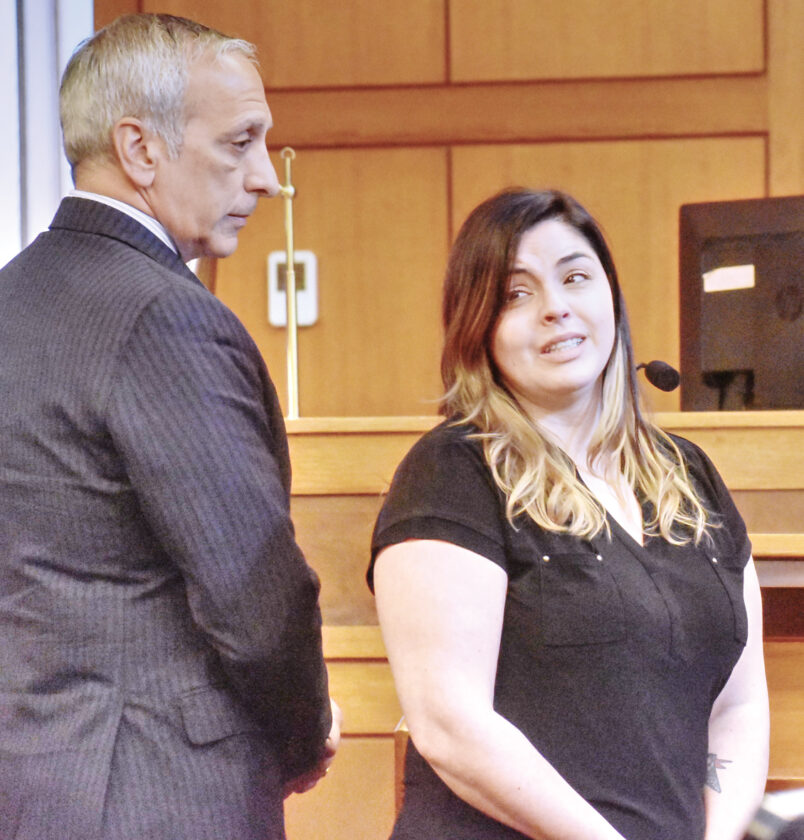
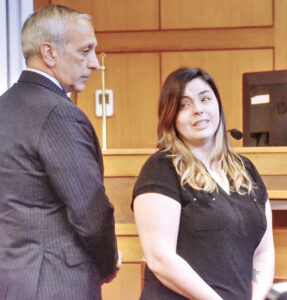
Staff photo / Ed Runyan Britni Ulam, 36, who has addresses in Warren and Niles, turned to apologize to the family of Frank Walter, 31, of Cortland, who died in an early-morning crash on state Route 46 in Bazetta on Nov. 3, 2024. Ulam got four years in prison after pleading guilty to aggravated vehicular homicide and drunken driving. Her attorney, Robert Shaker, is at left.
WARREN — Before Britni N. Ulam, 36, learned Wednesday that she was going to prison for four years for a drunken crash on state Route 46 near Tamer Win Golf Course in Bazetta that killed her passenger, Frank Walter, 31, of Cortland, she heard from Walter’s brother, sister and mother.
Ulam has addresses in Warren and Niles.
When the hearing first started, Ulam turned to Walter’s family members in the courtroom and apologized several times.
“I just want to say I am so, so sorry that we are even here today. If I could change places with Frank for him to be here today, I would,” Ulam said.
Walter’s brother, Eric, told Ulam he experienced substance abuse himself, prison and now recovery and got better when he engaged in programming and found productive things to do with his life.
He said he believes Ulam is a “good person” and hoped she would get a long probation with substance abuse treatment.
“I want to see you have a future, that my brother did not pass away for nothing. I want to see you have a life and live it out for him,” Eric Walter said.
He let out a long sigh before telling her, “I’m not mad at you. I just pray you have a good life and learn from this.”
Walter’s mother, Lisa Keenan, told Trumbull County Common Pleas Court Judge Cynthia Wescott that Frank was born with a club foot that doctors said would limit him. But he never let it.
“Any time he fell down, he got back up,” she said. “He never let anyone — for long — keep him down. And I hope the same thing happens with Britni, that she doesn’t let anybody keep her down for long. He wouldn’t want that.”
As a mom, she said she is working on forgiving Ulam.
“It’s hard feeling your child ripped out of your body. It’s hard not hearing the laugh, seeing his smile.” She said her son “was there for everybody. My whole family’s been ripped apart. I went and ripped myself apart. It’s just been really, really hard.”
Frank’s sister, Marina, said she too wants to see Ulam get help and learn to be accountable “so that something like this doesn’t happen again. I don’t want to see your life ruined either.”
The crash that killed Walter happened at 1:24 a.m. Nov. 3, 2024, as Ulam drove a 2006 Nissan Exterra SUV north on Route 46 at a high rate of speed and failed to navigate a curve near the golf course driving range, according to a crash report from the Ohio State Highway Patrol.
The vehicle drove off the right side of the road, struck a ditch, then struck a culvert and overturned several times, ejecting Ulam and Walter. The SUV also went off the left side of the road and went down an embankment, the report states.
As emergency responders were en route, a southbound 2014 Nissan Altima driven by a Niles woman struck Walter, who was lying in the road, resulting in his death. Neither Ulam or Walter were wearing seatbelts, the report states.
Ulam’s blood was later tested at 0.339 for alcohol, which is more than four times the legal limit in Ohio to drive of 0.08. Also found in her blood were benzodiazepines and opiates, according to the crash report.
Investigators determined that alcohol and excessive speed were contributing factors in the initial crash. Ulam had suspected serious injuries, and was taken to St. Elizabeth Youngstown Hospital.
In sentencing Ulam, Wescott said Ulam showed genuine remorse and engaged in substance abuse treatment. In addition to the four years in prison, Wescott imposed a three-year driver’s license suspension. Wescott said Ulam had no prior felony convictions, but has a history of traffic citations, “specifically related to speed dating back to when she was a juvenile.”
Ulam pleaded guilty earlier to aggravated vehicular homicide and operating a vehicle under the influence and could have gotten up to five years in prison. A sentencing memorandum Ulam’s attorney, Robert Shaker, submitted to Wescott stated that Ulam was found unconscious on the road after the crash and was treated for a fractured neck, back, ribs, pelvis, scapula and surgically reconstructed left foot and collapsed lung. She was hospitalized from Nov. 3 to Nov. 27, 2024, and was in a wheelchair until February of 2025, the memorandum states.
The filing stated that an Ohio State Highway Patrol trooper spoke with Marina Walter after the crash and learned that Frank Walter had “relapsed” and picked up Marina from work while drunk at 11:30 p.m. Nov. 2. He was alone in his Toyota. He told Marina “Britni was going through a rough time with her boyfriend and he was going to spend some time with her.”
Britni Ulam picked Frank up in the Xterra about 11:45 pm. at the apartment where Frank and Marina were living. That was the last contact she had with Frank, Marina said, according to the document.
After the hearing, Walter’s family clarified that Frank and Ulam were not in a relationship. They worked together and were good friends.
Before the hearing began, Frank’s mother, brother and sister participated in the first Victim-Offender Conferencing in Trumbull County Common Pleas Court in Wescott’s courtroom with Trumbull County Adult Probation officer Wanda Cunningham as moderator. Cunningham is a former victim advocate for Warren Municipal Court who is trained in that type of session.
Victim-Offender Conferencing “is a process used in many communities to bring victims and offenders of crime into dialogue,” according to a news release from Wescott’s magistrate, Mary Ellen Ditchey.
“The process gives the victims of the offense an opportunity to express to the defendant how her criminal conduct has affected their lives. It gives victims an opportunity to have a voice in the criminal process and is designed to provide some closure to their trauma,” the release states.
“The process holds the offender accountable to the person or persons harmed and allows the defendant the opportunity to take responsibility for their actions and to apologize and to express their remorse for their criminal conduct.”
It is not a speciality docket, like drug court, Westcott said. Wescott was not present at the conference, she said. She learned of the concept while attending a national judicial conference in 2023.
Local News
Man accused of fighting with police at St. Joe’s
WARREN — A Warren man accused of swinging an IV pole at hospital police bonded out of jail, but failed to appear ...
YSU grad student creates web accessibility scanner
Youngstown State University graduate student Dil Rawat is using his capstone project in the Master of Computing and ...
Hubbard to conduct 2-day branch collection
HUBBARD — The city’s street department plans to conduct a branch pickup Monday and Tuesday. A news release ...
Grand jury refuses to indict girlfriend of man convicted in near fatal stabbing
WARREN — A Trumbull County grand jury has refused to indict Zulekha M. Berry, 46, of Warren, on any charges in ...
Bristol officials consider forming fire district
BRISTOL — Because of concerns about inadequate staffing at the fire department, township trustees are looking at ...