
Preserving the past presented at workshop
Trumbull County Historical Society helps history buffs
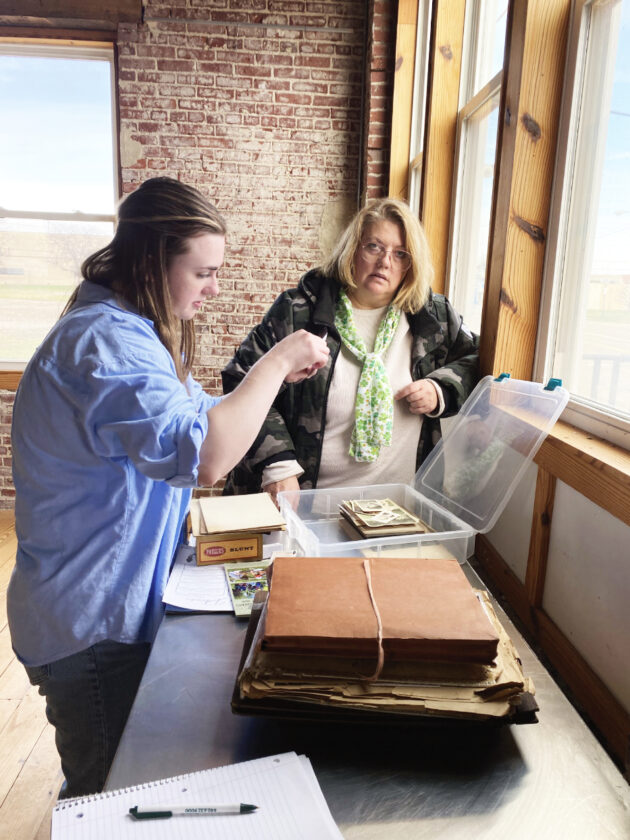
Correspondent photo / Karla Dines Area residents learned ways to preserve family photographs and other memorabilia Saturday afternoon at the Museum of Science Fiction and Fantasy, where the Trumbull County Historical Society hosted a preservation workshop. Heather Paisley of Mantua, right, arrived with a large plastic box containing old photographs and negatives. TCHS Archivist Kate Pfouts advised Paisley on materials and methods for preserving family memorabilia, including PVC-free sleeves.
WARREN — About a dozen area residents learned ways to preserve family photos and other memorabilia Saturday afternoon at the Trumbull County Historical Society’s preservation workshop at the Museum of Science Fiction and Fantasy.
TCHS Archivist Kate Pfouts and Collections and Research Manager Savannah Moss discussed ways to slow the deterioration of photos, slides and other materials.
Slowing down the inevitable deterioration of grandma’s and grandpa’s love letters in the old cigar box, the decades-old newspapers, long yellowed with age, and the many boxes of old photographs in the basement can be done with the proper techniques and materials.
“Preservation means trying to slow down the inevitable deterioration. There is no way to stop it completely,” Pfouts said.
Pfouts and Moss taught methods for digitizing records, where to purchase archiving materials and when it may be necessary to reach out to professional conservationists, as well as the TCHS Digitization Services they offer.
Discussed were the importance of storing items at room temperature with a relative humidity level between 35 and 44%, in the main part of the house and away from dust, pests and sunlight.
Charlene Wilson of Champion registered for the workshop after reading about it in the newspaper. She is interested in preserving her father’s high school diploma.
Heather Paisley of Mantua arrived with a large plastic box containing old photographs and negatives after learning of the workshop on social media. After Moss and Pfouts presented their preservation information, Pfouts met with Paisley and provided advice about materials and methods Paisley can use to preserve the family photos and negatives such as the use of PVC-free sleeves.
“My mom passed away last year and I got the family photos. I would really like to organize them and share them with the family,” Paisley said.
Doug Pfouts of Akron, father of Kate Pfouts, brought a large container of family artifacts, including birth and death certificates, old family bibles and newspapers. Pfouts said that his family on both parents’ sides fought in the Revolutionary War.
“We have a lot of history. My mom did genealogy. My mom’s family came over with William Penn. I want to digitize everything so I can pass it on to my family,” Pfouts said.
He brought out a few of his artifacts — a “World Atlas of the World at War,” Tecumseh Sherman Pfouts’ five-year diary, dated 1937, and his father’s dog tags.
Moss and Pfouts discussed storage supplies safe for different artifacts, including acid-free and lignin-free paper and tissue. They explained that unbuffered tissue paper is safer to use than buffered paper. A makeup brush and sponge are good for removing particles. Freshly washed hands are a must. They recommend using nitrile gloves to protect the handler from potentially harmful substances on the artifacts and to protect the artifacts from skin oils. The use of a pencil, not a pen, when labeling the back of photos was stressed.
Preservation supplies are generally available on Amazon. Archival Methods sells a Family Archive Kit that has everything one needs to get started, including a document box, gloves, folders, envelopes and box labels.
“If this sounds overwhelming, we can help you. TCHS has recently begun a digitization service,” Pfouts said, which is headed by Moss.
TCHS offers a few other services. They can even digitize a photo in a picture frame without removing it or photograph great-grandma’s outfit.
The first step in using the service is to schedule a free consultation with a TCHS Collections staff member, where pricing can be discussed. The next step is to drop off items at the digitization lab. Digitized items are placed on a flash drive or uploaded to Google Drive.
Local News
Set in scone
Area residents, businesses deal with power outages
Heavy winds Friday and again Sunday caused many residents and some businesses in the Mahoning Valley to be without ...
Trumbull County court: Marriage licenses
Marriage licenses granted March 2 to 6 in Trumbull County: Christopher J. Anderson, 34, Warren, and Shirley A. ...

Warren student spells way to victory

St. Patrick’s Day comes marching into Boardman
Our Heritage: Elizabeth Thompson: A beloved friend and confidant to the Washingtons
EDITOR’S NOTE: This is part of a weekly series on our region’s history coordinated by the Trumbull County ...