Mathews reverses sports and extracurricular cuts
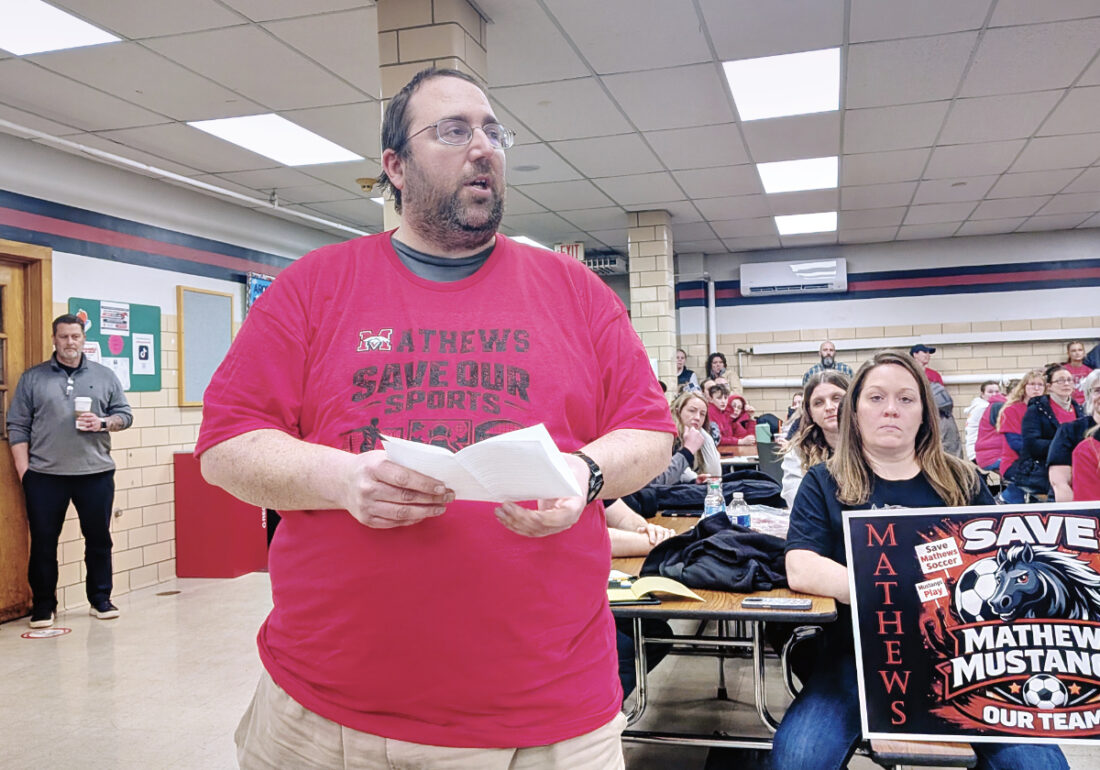
Staff photo / Brandon Cantwell Michael Michetti of Fowler was among the standing room only crowd at Wednesday’s Mathews Board of Education meeting, where parents and community members came out to show their support for sports and extracurricular activities that were on the chopping block because of the district’s financial woes. Superintendent Russell McQuaide reversed course on the decision after community outcry.
VIENNA — Several sports and extracurricular activities that were on the chopping block at Mathews High School will be safe, the district’s superintendent said Wednesday.
Mathews High School’s cafeteria was clad in red for the board of education’s regular meeting as parents, students and community members showed support for the district’s extracurriculars — wearing shirts that said: “Save Our Sports – Soccer – eSports – Track and Field.”
Superintendent Russell McQuaide, during his report, said there wasn’t anything they couldn’t compromise, adding it was nice to see the standing-room only attendance at the meeting, but he also wanted to explain his perspective.
McQuaide said he was approached around mid-January by Treasurer Bradley Panak, who told him that the district needed to work on sports spending, noting that they were overspending.
McQuaide said he approached Mathews High School Principal George Garrett and athletic director Michael Palumbo, as they were the experts when it came to sports.
McQuaide said the Trumbull County Commissioners began discussing expanding the homestead tax credit for homeowners and the owner-occupancy credit.
“The homestead tax credit would hit Mathews for $160,000. The home occupancy credit would hit Matthews for $72,000,” McQuaide said. “I heard they’re going to do the vote in July, which is when our fiscal year starts, so it will impact fiscal year ’27 — whether they pass one or pass both, it’s going to impact Mathews.”
McQuaide said the district was projected to lose $592,448 in state funding the previous year, but the loss ended up being $396,000.
He said the district maintained all the programming it had and made progress, adding that they’ve tried “very hard” not to impact programs.
McQuaide said Panak presented the district’s five-year forecast a month later, which included worded uncertainties like “forecast” or “projecting” because school officials don’t know what’s to come in July regarding tax credits.
McQuaide said the district was projected to show deficit spending in 2027, something he considered “very real” because of some of the shifting officials did, noting a $898,719 loss was supposed to occur, but they were able to keep it down to $574,719.
He reminded everyone that the number was a projection, but a “pretty good estimate” of where the district was at the moment.
“When people hear deficit spending, they think we’re totally broke, and we’re not broke. It means that we are spending more than we are taking in during that school year,” McQuaide said.
He said the district is projected to end fiscal year 2026 at $4.3 million in unencumbered revenue, adding that school officials have still been good money managers.
“However, if we keep beating down the deficit spending trail, right around fiscal year 29, we’re going to have gigantic trouble,” McQuaide said. “For the interim, we’re not in trouble, yet, not at all.”
McQuaide said he targeted reductions in sports because the district is in the midst of scheduling for the fall season, so any cutbacks had to be “pretty soon” if officials intended to make them happen.
McQuaide admitted he was responsible for suggesting such a route, as the district needed to take $40,000 to $50,000 out of its budget.
McQuaide said the specific sports — indoor track, eSports and soccer — were targeted for their respective struggles, noting that the high school soccer team only had 18 players and they were fielding a co-ed team.
“Esports — we have a lot of kids sign up, but then they don’t show up; as a result, we’re thinking, ‘Is it practical to maintain that program?’ A lot of them are actually participating in other sports at that time or other activities that we offer,” McQuaide said. “Indoor track. It’s my understanding that we only had about seven kids on indoor track last year.”
McQuaide said there are supposedly 130 kids in the youth soccer league, which he said is great, but it wasn’t translating to the high school, adding that they would have several other teams and not a co-ed one if more kids signed up.
McQuaide asked parents to support the soccer program and encourage their kids to participate when they get to high school, saying that is where he was having a “disconnect.”
McQuaide said he wasn’t going to make any recommendations to cut programming at this point, expressing the intention to “sit tight” and see how things shake out because it’s the community’s wish.
Regarding the March 11 informational meeting, McQuaide apologized to Palumbo and Garrett, whom he said put themselves out there to facilitate conversations.
“I would also like to apologize to the students of Mathews — the soccer teams, the indoor track people, the eSports people — as well as the families, the parents, the community. I’m very sorry if I misstepped,” McQuaide said. “I probably moved a little bit early, but again, these things are based off (of) projections. I’m trying to be proactive.”
PUBLIC COMMENT
Michael Michetti, an alumnus and member of the inaugural soccer team, credited the school for allowing him to play collegiately with grants and scholarships.
“Over 30 years ago, my dad stood before the board with (the) Mathews Youth Soccer League to get soccer started at Matthews High School,” Michetti said. “MYSL funded, for two years, to get it going, and they packed the tiny little room over there, down the stairs and out into the parking lot to show (support).
“The support that you see here is what we had then, and all the way through,” he added.
Michetti said they’ve learned a lot from the community, people who have sent messages and alumni, about things in the budget that was provided.
“If we’re going to cut anything down the athletic budget, you need to do it equally along the whole way,” Michetti said. “You need $50,000, that’s 15% of your athletic budget. Every sport needs to sacrifice 15%, and if you can’t get it exact, you go a little more on the ones that you know can afford it.”
On fielding more soccer teams if there is more interest, as McQuaide suggested, Michetti said the high school soccer team started as a co-ed team and would die as one, unless enrollment triples or quadruples at the school.
Carter Jones, a junior, said he had a speech planned for the meeting, but instead thanked McQuaide for his decision.
“I know that there’s a lot of kids that I’ve known since I was like, 6 or 7, and I’ve been playing — I played all the way up through the youth soccer program since I was just like tiny,” Jones said. “I never, never once thought about playing anywhere else, even though I might not have always won the games all the time.”
Local News
Man accused of fighting with police at St. Joe’s
WARREN — A Warren man accused of swinging an IV pole at hospital police bonded out of jail, but failed to appear ...
YSU grad student creates web accessibility scanner
Youngstown State University graduate student Dil Rawat is using his capstone project in the Master of Computing and ...
Hubbard to conduct 2-day branch collection
HUBBARD — The city’s street department plans to conduct a branch pickup Monday and Tuesday. A news release ...
Grand jury refuses to indict girlfriend of man convicted in near fatal stabbing
WARREN — A Trumbull County grand jury has refused to indict Zulekha M. Berry, 46, of Warren, on any charges in ...
Bristol officials consider forming fire district
BRISTOL — Because of concerns about inadequate staffing at the fire department, township trustees are looking at ...