
Lacers share their artistry at library
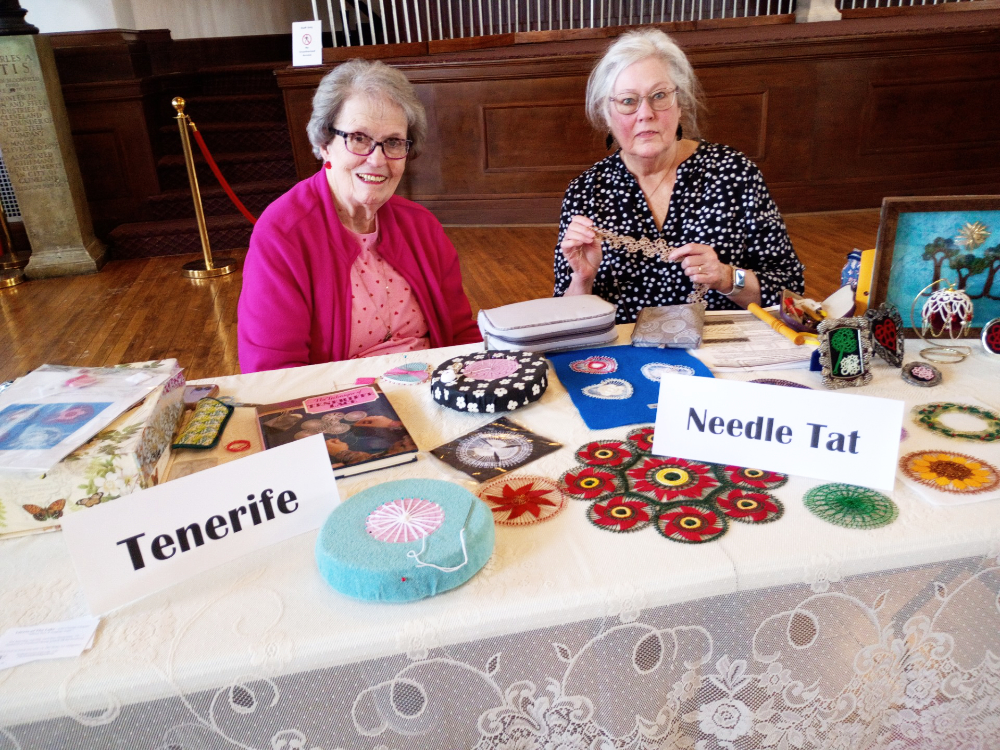
Correspondent photo / Susan Wojnar Bonnie Toth, left, and Jean Reardon, members and demonstrators for Lacers of the Lake, share needle tat and Tenerife techniques during a workshop Saturday afternoon at the McKinley Memorial Library. The group is based in Cortland but does demonstrations all over the county, mostly at libraries and art galleries.
NILES — Lace may conjure images of antique doilies and heirloom trim, but at the McKinley Memorial Library on Saturday, members of Lacers of the Lake showed that the craft is far more dynamic than nostalgia suggests.
Through demonstrations and personal instruction, the Cortland-based group revealed the complexity, history and continuing evolution of handmade lace to curious visitors.
Founded in 2013, Lacers of the Lake — often referred to as LOL — is a charter chapter of the International Organization of Lace. According to member and demonstrator Holly Lacusky, the group’s mission is to bring together like-minded people interested in making, teaching, preserving and demonstrating lace so the craft continues for future generations.
“We’re a very casual group that meets on the third Saturday of the month from 10 a.m. to 1 p.m., alternating between the Cortland and Howland public libraries,” Lacusky said. “It’s free and open to anyone with an interest in lacemaking.”
The group typically meets from March through November and keeps its Facebook page updated with meeting locations and times. In addition to monthly gatherings, members teach classes and present demonstrations throughout the community. They have exhibited at the Trumbull Art Gallery and offered occasional classes at Trumbull County libraries.
The name “Lacers of the Lake” reflects the group’s proximity to Mosquito Lake.
LACING DEFINED
The Smithsonian Institution defines lace as “an ornamental openwork fabric created by looping, twisting, braiding or knotting threads by hand or machine.” The Lace Guild similarly describes it as fabric composed of designs formed by solid areas among spaces, usually created with a thread and needle.
“Lacing is creating a textile with varying openness using tools like bobbins, needles, shuttles and hooks,” Lacusky explained. “It can be made with hair-thin thread clear up to yarn and larger, depending on the desired outcome.”
During Saturday’s event, members demonstrated bobbin lace, tatting, needle lace, needle tatting, Teneriffe lace, hairpin lace, knitting and crochet. Finished pieces were displayed alongside specialized tools — pillows, shuttles, lucets and carefully wound bobbins — as well as historical information about each style.
Attendees were invited to sit down with demonstrators and try the techniques themselves.
“Anyone who tries something or has an interest will be invited to join us at our meetings,” Lacusky said.
The library also has expressed interest in hosting a future class if there is sufficient demand.
AMERICA’S OWN LACE
Bobbin lace is Lacusky’s favorite style, and she focused her demonstration on American Ipswich bobbin lace — the only lace developed in the United States.
The lace originated in Ipswich, Massachusetts, in the late 1700s, when lacemaking became the town’s primary industry.
“There is a ton of history with it,” Lacusky said, noting documented connections to figures such as Alexander Hamilton and George Washington, as well as Martha Washington. The lace industry also played an important role during the Revolutionary War era.
Lacusky first encountered bobbin lace at the Shaker Woods Festival in Columbiana about 30 years ago. “I was hooked,” she said. She has been actively making it for about 25 years.
“I enjoy the challenge, the structure and the rhythm of the hand movement when I get in the zone,” she said.
Bobbin lace is created on a firm pillow designed for the specific type of lace being made. Thread is wound around pairs of bobbins — slender, often decorative wooden spools — then twisted and crossed in precise sequences to form stitches.
PRESERVING THE DYING ART
Member and demonstrator Kathy Lovell of Cortland emphasized that lacemaking encompasses far more than many people realize.
“Many people think of lace as tatting or crocheting — that’s what their grandmothers did,” Lovell said. “Lacemaking is so much more. There’s bobbin lace, knitting, shuttle and needle tatting, button making — not how most people think of buttons — and the lucet.”
Some techniques date back to 18th-century Europe. The lucet, a small pronged tool used to create strong cords, is believed to have been used as far back as the Viking era to make nets.
“Lacemaking is a dying art, and we are committed to keeping it alive and relevant,” Lovell said.
Historically, lacemaking was often a cottage industry that provided essential income for families. In some regions, it was more profitable than farming. Techniques were closely guarded, and each area developed its own distinctive style.
Jackie Mountan of Youngstown, another member and demonstrator, noted that during the Irish potato famine, organized lacemaking became a crucial source of income for struggling communities.
“Techniques were guarded,” Mountan said. “You couldn’t just take your skill elsewhere. Each region had its own style.”
SCREEN TIME DISTRACTION
For member and demonstrator Jean Reardon of Sharon, lacemaking offers something especially valuable in today’s digital age.
“It’s a welcome antidote to excessive screen time,” Reardon said, noting that the craft provides focus, creativity and a tangible sense of accomplishment.
She described needle tatting — a portable technique using a long, blunt needle and cotton thread — as a method of forming rings, chains and decorative loops called picots. Teneriffe lace involves needle and thread worked in a series of knots.
Lovell added that she appreciates the delicacy of the craft and how both fine and thicker threads can produce equally beautiful results. Members enjoy offering classes and one-on-one instruction, and their displays — including one set up in the McKinley museum — aim to spark curiosity and preserve knowledge.
As threads crossed and twisted Saturday afternoon, what emerged was more than decorative fabric. It was history, artistry and community woven together — one stitch at a time.
Local News
Liberty to expect fiscal prudence
LIBERTY — It could take a little more time for the township to come out of a state of fiscal prudence, trustees ...

Man gets 8 to 12 years for near-fatal Niles stabbing
On the record: Vienna
WHAT: Township trustees meeting Tuesday PRESENT: Michael Haddle, Kim Ellis and Phil Pegg Trustees: • ...

Cortland City Council selects newest member
Girard OKs raising fees for vacant buildings
GIRARD — City council voted 7-0 at their meeting Monday to increase the registration fees on vacant commercial ...
Hubbard trustee gives Coalburg Lake update
HUBBARD TOWNSHIP — One trustee noted a potential setback in the process of a purchase of a lake with a dam slated ...