
Meeting explains diverging diamond project
Trending
WARREN -- With the diverging diamond project entering its final phases and a potential October completion date, Ohio Department of Transportation District 4 officials sought to answer questions about the project Wednesday night.
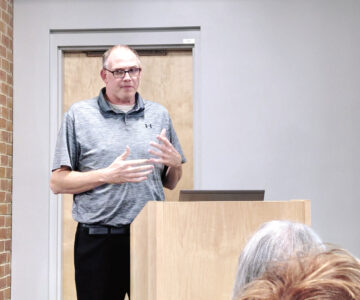
Nearly every chair in the Warren-Trumbull County Public Library's Harding Room was filled as Justin Chesnic, District 4's public information officer, and Michael Simpkins, ODOT District 4 construction engineer, hosted a 15-minute presentation describing the construction and its impact on motorists.
Chesnic said between 2012 and 2016, the area at state Routes 46 and 82 experienced 159 crashes, ranking it "fairly high" on the safety rankings on the department's safety improvement plan and number one for Eastgate Regional Council of Governments.
Simpkins said adding lanes to the preexisting configuration "wasn't feasible," adding that they were trying to maximize how they could get vehicles through the interchange. He said things got to the point where ODOT added a double left-turn lane and maximized the possible time on one of its signals.
The signal is one of the few that has a "leading and lagging left turn," Simpkins said, meaning when a motorist comes to it, they get a left turn phase before someone heading northbound on Route 46 gets a green light. Before the end of the phase, they also get a left turn because the volume is "just so heavy."
However, Simpkins said double left turns presented their own problems.
"They also present issues that people have a tendency to drift into the other lane, as you're making that double lap," Simpkins said. "They eventually have to merge together on the ramps, so there are issues with that, so they do fix some things as far as being able to move traffic through there, but at some point, it's still a problem."
Simpkins said a diverging diamond allows traffic to be "free-flowing," with traffic lights timed out at 40 seconds both north and southbound, and signage everywhere to prevent confusion and keep motorists in their own lanes so they'll know where they're going. There are also lanes dedicated to certain areas, like ramps.
"There should be no confusion; when you see the shield on the pavement, that if I'm not going to 82, I need to get over," Simpkins said. "That's how we're putting these pavement markings down on the pavement -- to kind of help give you that visualization, that if I want to stay on 46, I need to stay in this lane."
PUBLIC COMMENTS
Howland resident John Schuster asked about the lag time on the area's lights, noting a five-car accident at the Howland-Wilson Road and Route 82 intersection is a sign that there is an issue with people running lights.
Simpkins said the traffic lights' phases were more like 20 seconds minimum, 40 maximum, with an "all red" phase that would clear the intersection altogether.
Schuster asked what ODOT's plans were for winter, as while the shields on the pavement help during warm days, there could be a period where they are covered in snow -- making it awfully confusing as the project concludes on the cusp of winter.
"So there are lane-use control signs, so the white signs and the black arrows showing which lane you need to be in," Simpkins said. "We have those here on the project, on both sides coming in there, and so the payment markings are strictly a supplement to that."
Gary Machin, Warren's planning and development director from 1968 to 2002, recalled a time when Lowe's Home Improvement was built and the Sam's Club was just a vacant field. He said that engineers added a 15-foot right-of-way from Route 82 flowing into Niles, after traffic was backed up in the area from Thanksgiving to Jan. 1 of that year.
Machin said the third lane worked for 30 years and it was safe. He said that, with safety in the area being a primary concern, he did not think the diverging diamond would improve things, but only make it worse.
"It works, it functions, it works well, no wrecks when you're going into your own empty lane and you have a thousand feet or longer to either pull in or to merge into the other two lanes," Machin said of the previous arrangement. "With this new proposal, you've got two lanes coming into two lanes; you have no third lane. Except to drive down a ways and then cut back over. But you're gonna have to merge. There's no free flow."
Machin proposed that ODOT leave it as it was and allow the third lane to go down to the businesses in the area. There would be no collision problems because motorists would be in their own lane, turning right.
"It works, why change something that works?" Machin said.