
Next stop, Trumbull history
Society bus tour visits Underground Railroad sites
Trending
WARREN -- Many of those who risked their lives escaping from the bondage of chattel slavery and trying to make it to Canada found safe, temporary refuge in the heart of Trumbull County.
"They were often smuggled in wagons and other vehicles," Amy Fluker, a Youngstown State University associate professor of history, said.
In the 1800s, the county was a bastion of opposition to slavery, largely because many early settlers came from New England. It also was home to an estimated 30 anti-slavery societies, she noted.
Much of the county also was dotted with safe houses for freedom seekers, several of which were the subject of an Underground Railroad bus tour Saturday that began and ended at the Trumbull County Tourism Bureau, 321 Mahoning Ave. NW. In between, participants stopped at such sites in Brookfield, Gustavus and North Bloomfield.
The traveling history experience was in conjunction with the Trumbull County Historical Society.
In Warren, the bus stopped near Courthouse Square at the former Leicester King home, which was built in 1828 but destroyed in a 1981 fire. King, who moved to the city in 1817 from Westfield, Massachusetts, was a two-term Ohio senator, a Trumbull County Common Pleas Court judge, a member of the Liberty Party (a forerunner to the Republican Party) and a staunch abolitionist who became an Underground Railroad "conductor" who used his home to hide freedom seekers.
The second stop near downtown was at the former High Street home of Levi Sutliff, a prominent attorney and abolitionist who helped establish an anti-slavery society in 1832 in Trumbull County.
"Levi and his brother, Milton, helped found the American Anti-Slavery Society in Philadelphia," Fluker said, noting that state Route 45 was known as the Warren-Ashtabula Turnpike and often was used as an escape route to Lake Erie and, eventually, to Canada.
She added that many enslaved people -- mostly young men -- were able to make it across the lake via friendly and sympathetic boat captains, as well as on Canadian or British vessels.
In addition, Levi Sutliff, who also used his residence as a safe house, once traveled to Virginia to return an enslaved man to Salem. On the trip, he brought home a heavy iron hobble many slaves were forced to wear around their legs as a grim reminder of the evils of the institution, she explained.
One of the Sutliffs' most prominent guests was Sojourner Truth, who often gave lectures on the evils of slavery while in Warren, Fluker said.
In Brookfield, Fluker discussed the significance of the Obermiyer House and Ambrose Hart general store and boardinghouse, also used to harbor freedom seekers -- many of whom came from Youngstown and Poland. An estimated 60 of them stayed there during a seven-year period, she noted.
The structure also had a tunnel in its basement that freedom seekers were able to use before heading to their next destinations -- often Hartford and Kinsman. A shoe and a piece of a shackle were found in the basement, though it's unclear whether the items were left by anyone escaping slavery, Fluker said. She added that at one point, 14 seekers were at the home simultaneously, requiring some of them to be hidden in an adjoining barn.
The next stop took participants to the George Hezlep House, built in 1840 in Gustavus, that featured a closet likely used as a hiding place for those escaping slavery. Hezlep, who also ran a general store, once tricked slave catchers in the area into believing a freedom seeker named George Gray had left for Ashtabula, sending them there while hiding Gray, Fluker said.
The final two stops, in North Bloomfield, were Center Brook Manor (also known as the Charles Brown Gothic Cottage) and, across the street, the Brownwood Farm property.
Ephraim A. Brown Jr. who arrived from Cheshire, New Hampshire, built the Brownwood home, and his son, Charles Brown, a well-known abolitionist, lived at Center Brook Manor. The Brownwood property was vast and expansive, and contained a swamp on which was a hut used to hide some freedom seekers.
In addition to providing a temporary safe stop for those heading north, Charles Brown and his wife, Julia, were a pivotal part of the Disciples of Christ Church, of which he was an elder.
In 1850, the church established the Western Reserve Eclectic Institute that, in 1867, became Hiram College, Fluker said, noting that Leicester King, who also served in the 7th Ohio Infantry, was Julia Brown's father.
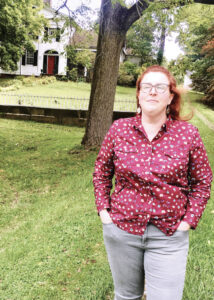
In 2018, Roger Peterson and his wife, Heather Peterson, bought Center Brook Manor and are restoring it as a living history site, as well as recapturing its 1840s splendor. In addition, Roger Peterson offered a walking tour as part of the Underground Railroad bus tour Saturday.
Fluker stressed that even though Ohio was considered a free state, enslaved people who made it there were far from safe because of fugitive slave laws that gave slave owners the right to capture and claim them as property without warrants. Those who were caught usually were taken before commissioners who were paid double for ruling in the owners' favor, she said.
The Buckeye State also enforced so-called "black laws" that, beginning April 1, 1807 -- four years after Ohio became a state -- stripped blacks from testifying in civil and criminal cases in which one of the parties was a white person.
According to the Montgomery, Alabama-based Equal Justice Institute, the discriminatory laws required blacks who moved to the state to register with county clerks within two years, pay a fee of 12.5 cents, obtain a court order attesting to their freedom and, at any time, produce such proof.
Among other things, white employers who hired unregistered black people faced fines of $50 per worker. In addition, employers were fined 50 cents per day for which they kept employees who were freedom seekers -- money that went to enslavers. Those who harbored or hindered the capture of freedom seekers faced $10 to $50 fines, according to the EJI.
From all aspects, mustering the courage to escape the bonds of slavery was dangerous at every turn. If captured, they often received severe beatings and other harsh treatment that included death, Fluker stressed.
She also differentiated between the views of abolitionists and those who took the more conservative stance of merely being against slavery. Many who supported the view of abolitionism were branded as radicals, Fluker added.