
Valley officials sail for prosperity
Speakers address needs and benefits of lake
Trending
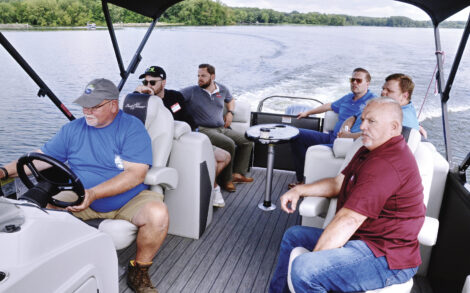
BAZETTA -- Representatives of several governmental agencies and area stakeholders met to discuss invasive plant species, the economic impact of Mosquito Lake and other topics during a "Morning at Mosquito" event Friday.
The gathering took place at the Mosquito Lake State Park Beach Pavilion under gray morning skies as speakers competed to be heard over a mother bird feeding her nesting chicks in the rafters. Attendees included congressional representatives, employees of the Ohio Department of Natural Resources (ODNR) Division of Ohio State Parks and Watercraft, the Attorney General's Office, township, county and Warren city officials, and a speaker from Cleveland MetroParks.
One of the major topics was the environmental dangers posed by hydrilla, an invasive water plant species that first came to U.S. waterways as an aquarium plant, according to Mark Warman, aquatic invasive species coordinator for Cleveland Metroparks. The plant, which grows in thick mats in shallow waters of 6 feet or less, is a "gold medal winner" and "warrior species" in the world of natural competition, Warman said. Hydrilla is oxygenating and depletes the natural environment.
"It doesn't offer much to the ecosystem," Warman said.
Out of the water, hydrilla looks like a stringy rosemary bush. In the water, it appears to be a mushy green cloud floating just under the surface. It reproduces in the wild from bits and pieces that float free from the stem.
"Just a few small fragments can launch a population," Warman said.
The dangers of hydrilla to natural waterways are many. These include outcompeting indigenous plant species to produce a "monoculture" (an environment dominated by one species) that can impede recreational use of lakes and rivers and inhibit predator fish from hunting.
"Over time, these mats (of hydrilla) grow out of control and choke marinas and sheltered bays and make navigation a nightmare," a handout from Warman stated.
Since Mosquito Lake provides drinking water to the area, hydrilla poses a potential risk to the water people use in their homes and businesses, Amy Reeher, district administrator for the Trumbull County Soil and Water Conservation District said.
Hydrilla also can pose a problem with its seasonal die-off in the fall when mats break free of their roots.
In 2019, a large clump of dead hydrilla blocked the outflow control structure at Pymatuning Reservoir in Ashtabula County. The Army Corps of Engineers was forced to hire underwater divers to clear the apparatus, Warman said.
Plans to combat hydrilla are long term, Warman said, and it could take seven to 10 years to get the plant under control. People can combat the spread of hydrilla by cleaning mud and plant fragments from anything that touched the water, including boats, propellers, trailers, waders, and boots, according to the hanout.
Warman said that anyone concerned that a private or public body of water is contaminated with hydrilla should contact the ODNR invasive species webpage at https://ohiodnr.gov/discover-and-learn/animals/invasive-species.
ECONOMIC IMPACT
Several of the speakers on Friday discussed the impact of Mosquito State Lake Park on the local economy and made the case for further economic development.
"This year, year to date, the Mosquito Lake Campground has had 10,276 overnight stays," Jon Dobney, assistant chief of ODNR, said. "That's almost 1,100 more than last year. It continues to grow."
Dobney credited this uptick in usage to the improved facilities at the park, including new flush-toilets, improved boat ramps and increased handicap accessibility at the ramps.
In addition, the lake draws boaters. Overall, boating has a $6.4 billion impact on the state's economy, according to Dobney.
"And Mosquito (Lake) is a big part of that," Dobney said. "As we track our number of visitors -- day use and overnight -- Mosquito Lake is in the top dozen for visitors," he said.
The number of individual visits to the park is more than 900,000 annually, according to Beth Kotwis Carmichael, executive director of Trumbull County Tourism. "And it has no more mosquitos than any other lake," she joked with the audience.
However, more should be done to boost tourism and the local economy, according to Denny Malloy, Trumbull County Commissioners chairman. What the lake region needs are more amenities for tourists, he said.
"We've got wallets full of money coming every day and then they turn around and go home. We've got to do better for Trumbull County," Malloy, who lives in Bazetta, said.
Specifically, there is a lack of restaurants, shops and motels in the immediate vicinity of the park, he said. Malloy made a plea to local business leaders to develop the land that is now mostly covered by scrub and trees. This includes the need for more and improved infrastructure, he added.
"Over the last 30 years or more that I've been on the lake, there's been very little (economic) progress," Malloy said. "The lake is beautiful, the fishing is great, the hunting is as good as it's ever been. But we need to do better when it comes to economic development."
Malloy acknowledged that not everyone wants to see the area developed, but emphasized that better amenities could make a big difference to local businesses.
"We are actually losing restaurants. We are actually losing grocery stores and we are not replacing them on the lake for lack of infrastructure. And these resources are dying on the vine. We are a better society than that. We're a better county than that," he said.
Malloy's hope is that local leaders can work together.
"Let's follow the lead of some of the things that Cortland is doing in revitalization and progress and let's adopt that for Mecca and Bazetta and Greene," he said.