
City ready to free the river
Warren continues work to remove the Summit Street Dam
Trending
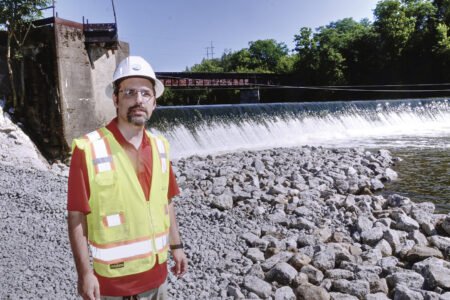
WARREN -- A long and eventful chapter of the city's work on the Mahoning River is set to come to a close with the ongoing demolition of the Summit Street Dam.
Mayor Doug Franklin said the removal of the dam is "critical" to the development of the Mahoning River Corridor.
"It's critical in the fact that this is a regional effort led by Eastgate Regional Council of Governments and the consortium of mayors along the river," he said. "We couldn't have gotten these projects and these dam removals funded without us as mayors along the Mahoning River collaborating in a real proactive way."
Patrick Rohr, project manager for the company conducting the demolition, RiverReach Construction, said in an email to the Tribune Chronicle that Warren has been awarded a $1,725,500 grant from the Ohio Environmental Protection Agency's water pollution control fund.
RiverReach was chosen through a quality-based selection process to serve as the design build team for the Summit Street Dam removal project. The contract for the project is $2,998,662 and was reviewed and approved by representatives of the Ohio EPA and the city's criteria engineer.
The Summit Street Dam project is not simply removal of the structure, but rehabilitation of the site as well.
"Removing the dam is just a component, one step, one critical step, in the restoration of the river and the revitalization of all of those other benefits to having a clean, free flowing river," Franklin said.
During the sediment dredging and dewatering portion of the project, crews are expected to remove more than 3,000 cubic yards of sediment material from the project site.
This sediment material, once collected, is pumped to geotextile tubes located in the dewatering area. The geotextile tube will allow for the sediment to be captured while the water is filtered out. Water will then be tested and discharged to the city sanitary sewer system.
Additional site restoration measures will be taken.
The removal of the Summit Street Dam brings to a close a chapter of Warren history that has been unfolding for nearly three decades.
A HISTORICAL SITE
The dam's original purpose was to provide hydro-electricity for an adjacent facility that has since been demolished -- the Mahoningside Power Plant.
Council President John Brown said the power plant was originally built in the late 1880s.
"Then, sometime later, it was turned into a coal fired plant, but that was the reason for the dam," Brown said. "That's the third dam at that location. Originally, there was a gristmill and then the city waterworks on the other side of where the plant was."
From 1950 until 1980, Mahoningside Power Plant was owned by the Ohio Edison Company and primarily used as a coal-burning power plant until 1968. In August 1977, the property was leased by Ohio Edison to Summit-Warren, where the property was used to operate a salvage business, according to the documents. At that time, the business was owned by Harold Glunt and John Petrilla. In December 1980, the property was sold to Nestor Stychno and William Marsteller.
In 1999, a bankruptcy agreement between the former property owners and the City of Warren was established to turn the long-vacant property over to the city.
Franklin said Mahoningside was unsecured, people were able to get into the building with relative ease, and the public safety risk was increased because of it being adjacent to the river and the dam.
After decades of sitting empty and blighted next to the Mahoning River, in March of 1999, then-Warren Mayor Hank Angelo and crews standing across the street pressed a button to ignite a controlled explosion, beginning the demolition of the 100-year-old power plant.
"It was a very celebratory mood and an atmosphere of excitement because the power plant was a monstrosity of just being a physical eyesore," Franklin said.
While the fall of the power plant was cheered by onlookers the day of the demolition, it would go down as part of an infamous event in the city's history. In the following years, it was discovered through FBI investigations that the contract to demolish the Mahoningside Power Plant was one of many awarded by Warren officials as part of an elaborate kickback and bribery scheme involving construction and demolition contracts, according to Tribune Chronicle archives.
CLEANING UP
According to U.S. EPA documents, the city of Warren consulted with both the federal agency and the Ohio EPA during the cleanup of the Mahoningside demolition site regarding "regulatory compliance should heavy metal contamination be discovered during the removal of basement debris."
The discovery of polychlorinated biphenyls, PCBs, was the beginning of the U.S. EPA's involvement in the cleanup. The discovery was made during the city's removal of debris from the former building's basement.
Warren at-Large Councilman Michael O'Brien was Trumbull County commissioner during the time of the demolition and Warren mayor during part of the cleanup.
"It was an environmental eyesore, well, it was an environmental nightmare actually," O'Brien said.
The then mayor said the cleanup was a $6 million project. He said it was funded by the U.S. EPA Superfund as well as funds from Clean Ohio and in-kind funds from Ohio Edison. He said Ohio Edison also funded fill dirt and a decorative fence.
O'Brien said the city had to go through two budget cycles with the U.S. government to receive the funds. He said no city dollars were spent on the site.
U.S. EPA officials said the first phase of the cleanup included removing approximately 1,800 tons of PCB-contaminated material and 25 pounds of mercury waste.
O'Brien said the materials had to be trucked to landfills accepting such materials.
"One was in Minerva, Ohio, the other in Michigan," he said.
O'Brien said the original intent for the former power plant site, which is now home to the Sleeping Giant mural, was that if an interested party wanted to develop the land, it would have to be developed and planned without a basement.
After being demolished in 1999, the cleanup of the power plant lasted until 2005.
THE NEXT CHAPTER
The removal of the Summit Street dam will play a key role in Eastgate's "River of Opportunity" plan, which seeks to rebrand and reidentify the river. According to Eastgate's website, the plan seeks to "give the river the credit it deserves and allow it to be our centerpiece for the valley."
Thus far, two of nine dams listed in the plan have been demolished -- one in Lowellville and one in Struthers.
Brown said with the removal of the Summit Street Dam, Warren is hoping to take advantage of the economic opportunities a free flowing river can provide.
"If you go to Cuyahoga Falls or Lowellville, you'll see the amazing transformation of these river towns," he said.
Brown said the city of Warren has embraced removal of the dam.
Another potential source of economic development for the city is the land where the Mahoningside Power Plant once stood.
In a 2005 U.S. EPA news release, the agency said cleanup work at the site was being done "with an eye on eventually redeveloping the property."
Franklin said that is still a possibility.
"That is a potential site of opportunity for development," he said. "It can be economic development in the traditional sense or by creating real, attractive public space for our citizens and visitors to enjoy."
Franklin said the city already has plans in its inventory to develop "an attractive greenspace," with viewing spots overlooking the river.
As the removal of the dam continues, city officials are ready to end the chapter of the Mahoningside Power Plant and Summit Street Dam.
"This dam removal has a series of a lot of chapters that led us up to this point," Franklin said. "Once that dam comes out, we'll be able to turn the pages of history and move into a new era that's environmentally friendly, that respects the ecosystem and natural habitats of the river and that creates a new economy that takes advantage of this beautiful resource that runs right through our city."