
Letting it glide
NASA helps local students with science program
Trending
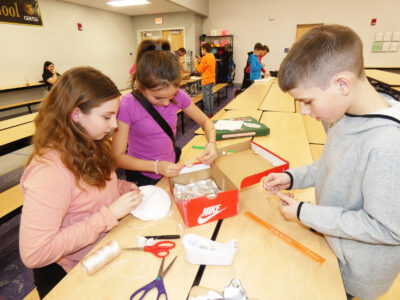
CHAMPION -- Students at Champion Middle School are using teamwork and science skills for an after-school program provided by the National Aeronautics and Space Administration.
David Murduck, a fifth-grade science teacher who leads the program, said NASA provides the training to lead the program called "Let it Glide Design."
He said the school district provides funds for the needed materials.
"We have received grant money through NASA almost every year," he said.
Murduck said this year students will make gliders, parachutes and rockets to go with the theme of being in the air.
"The main focus is often people get used to a certain idea in their mind on how something works. NASA likes the idea of children coming up with ideas that are totally different than what we normally think about," he said.
SHOEBOX GLIDERS
For this week's activity, students were making shoebox gliders.
Murduck said the goal is to get the gliders to glide similar to a paper airplane.
"They use creative thinking skills to create a glider that will be able to glide in the air as far as possible. They have to be careful on the way they push the glider. It could flip. They have to realize a hard force is not always the best answer when figuring out a way for it to glide" Murduck said.
He said what is very important is everyone learning to work together to solve a problem or challenge.
Murduck, who has led NASA-themed programs for the past 10 years, said while students brought in shoeboxes, the other materials were provided.
Materials include cardboard, paper, string, aluminum foil and duct tape.
Grayson Cecil, 11, and Arison LePosa, 11, both fifth-graders, said they have been practicing how to run and throw the glider into the air carefully.
"Getting everything to attach is the most challenging," Grayson said. "It is hard to keep all the pieces together."
Arison said they have to see what happens when the gliders are in the air and if all the pieces stay together.
Murduck stressed to the students that the glider should stay together and not fall apart.
Ayden Pumphrey, 11, said he wanted to make sure the shoebox stayed closed by using a lot of tape and string.
Ayden said he joined the program because he wanted to find out what STEM is all about.
"I was glad I took part in this," Ayden said. "It has been fun and I have learned a lot."
Shyann Preisler, 11, said she saw how much her brother liked science so she also wanted to give it a try.
"I wanted to see what it was like," she said.
Murduck said he likes how his students work together without him. He also receives assistance from high school students.
The science club and STEM programs are for fifth- and sixth-graders. There are 35 fifth-graders and 15 sixth-graders taking part, Murduck said.
"This is the largest group of fifth-graders I have ever had in STEM," he said.
High school science teacher Rebecca Baxter assists and brings her students with her.