
Life-changing bond
Woman donates organ because of her son’s transplant
Trending
YOUNGSTOWN -- They feel like they've known each other all their lives, but neither knew about the other until last September.
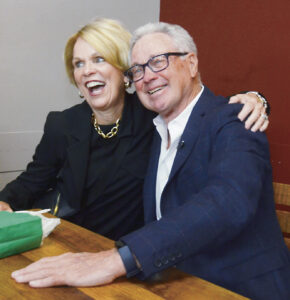
They embraced for the first time on May 19 with grins and tears before a celebratory lunch at V2 Wine Bar and Trattoria in downtown Youngstown.
Michael Dailey, 76, of Howland, silver-haired and fit, is an avid golfer who loves to work out in the gym. Linda Liberator, 67, of North Canton, with small hoop earrings and a mile-wide smile, was fresh off her latest 10K run. Both have August birthdays, and they share upbeat personalities and senses of humor.
They share a physical bond as well -- each carries one of Liberator's kidneys.
"Someone gave me part of her life to save my life," Dailey said Friday. "On Sept. 7, this beautiful lady gave me a kidney."
"I feel like I've known him forever," Liberator said, her eyes on Dailey.
"I have as much energy as when I was 20 years old," Dailey said. "It was like I got the fountain of youth."
But, Dailey said with his frequent laugh, "The guys said I have to still play off the men's tee even though I have a woman's kidney."
HOW IT BEGAN
The journey started in November 2021 when Liberator's son, ironworker Eric Jones, fractured his foot. When he went in for treatment, he registered extremely high blood pressure, and bloodwork showed that he was in kidney failure.
Jones, 45, admitted he wasn't very good at going in for regular checkups.
Jones said it's still a mystery how he fractured his foot. His doctor told him that it's common in kidney failure for the blood to steal calcium from the bones, leaving him susceptible to fractures.
Liberator said her interest in being a donor began in March 2022 after Jones was put on dialysis and it became apparent that he needed a new kidney.
"My son was diagnosed with end-stage kidney failure," she said. The retired operating room nurse understood, more than many, the consequences. "I used to pray that God would take me and not my son first. I had the medical knowledge to know this was not good."
Instead, she became passionate about becoming an organ donor. Working with the National Kidney Registry, she began the battery of tests to be a donor. "I was his perfect match, but I am 22 years older than him," she said.
Instead, she gave her kidney to Dailey and, because of his mother's donation, Jones received a kidney from a younger donor on Sept. 29.
"I'm giving them back their life. There's no better feeling than that," Liberator said.
DAILEY'S STORY
Dailey, a retired steelworker who spent more than 30 of his 48 years on the 56-inch hot strip mill at the former LTV mill in Warren, had been on the kidney recipient list for 4 1/2 years. In the meantime, he said, he enjoyed rounds of golf four days a week.
"Back in August, I went to University Hospital (in Cleveland) for my regular checkup. At the hospital, they noted something with my heart," he said.
His case had become more critical.
"The next morning, I was at Squaw Creek golfing when I got the phone call." A kidney match had been found.
The transplant date was set for Sept. 7.
Liberator also was notified that it was time. On her way to Cleveland the night before she donated her kidney at University Hospital, she began to cry. She assured her husband they were tears of joy: "Tomorrow morning, I am going to change someone's life. I'm going to give someone back their life."
She didn't know who, but that didn't matter.
First, surgeons remove one of the donor's two kidneys. A human can function normally with one working kidney. Shortly after the donor kidney is taken, it is transplanted into the recipient. Surgery went well for both, and both are back to their active lives.
For privacy reasons, recipients are not told who their donors are. Neither donor nor recipient see each other during the process even though they might be just around the corner from each other.
But Liberator, as the donor, was able to find out who had her kidney and sent him a card about a month after the transplant. He wrote back. Soon, regular telephone calls began.
"I felt bonded to him right away as soon as I heard his voice," she said. "I call him on the 7th of every month to say happy kidney-versary. We'll have cake on the one-year anniversary."
Dailey, who teared up often as he spoke about his gift of life, said, "When you wake up each day and realize you have another organ from another person in you … It's such a special day to me to meet her and her son."
JONES' STORY
"My kidney missed its plane ride," Jones said. He speculates that his donor lives in the southeast because a hurricane on the coast hampered travel that day.
His transplant was set for 2 p.m. Sept. 29. After waiting for his kidney to arrive and being bumped by a couple of other surgeries, his transplant finally happened about 11:30 p.m.
"It was a roller coaster ride," he said.
"I received a kidney from another perfect stranger," who has not contacted him, Jones said.
He knows it was because of his mother's gift to Dailey. "Take a penny, give a penny," Jones said.
Among the facts he said he learned during his journey are that the two leading causes for kidney failure are diabetes and undiagnosed high blood pressure. Also, there are more dialysis centers in the United States than there are Burger Kings, Jones said.
Jones, Liberator and Dailey all urged willing donors to sign up with the National Kidney Registry. All of the donor's medical expenses are paid. It's like receiving a free medical exam.
"Anyone can be a living donor. You need to be healthy and meet all the criteria," Liberator said. "I did meet the criteria, and am blessed beyond words. My father said, 'God prepared you for this.'"
Living kidney donation by the numbers
• 90,000+ -- The number of people in the United States waiting for a kidney from a deceased donor
• 3 to 10 years -- Typical wait time for a deceased kidney donor
• 90 days -- Typical wait time for a kidney patient to find a matched kidney from a living door through the NKR
• 10 to 15 years -- Length of time the average kidney from a deceased donor lasts
• 20 to 40 years -- Length of time the average kidney from a living donor lasts
SOURCE: National Kidney Registry
National Kidney Registry
The National Kidney Registry is a 501(c)(3) nonprofit organization based out of Greenwich, Conn. Contact the organization at www.kidneyregistry.org. The group states as its mission "to save and improve the lives of people facing kidney failure by increasing the quality, speed and number of living donor transplants in the world while protecting and supporting all living kidney donors."
• Living kidney donation is when a living person donates one of their kidneys to someone whose kidneys are no longer functioning properly. The donated kidney is surgically removed from the living donor and transplanted into the recipient.
• Since 1954, when the first successful living donor transplant took place in Boston, living donors have been giving the gift of life and making a difference. This tradition has allowed thousands of people facing kidney failure to live longer, healthier lives, free from the challenging routine of dialysis.
• A kidney transplant is used to treat kidney failure. People with kidney failure, also called end-stage kidney disease or renal failure, need either dialysis or a kidney transplant in order to stay alive. Most kidney disease is caused by diabetes or high blood pressure, but can also be caused by glomerulonephritis, polycystic kidney disease, birth defects, lupus and other immune diseases, obstructions like kidney stones or tumors, or repeated urinary infections.
Source: National Kidney Registry