
YARS commander describes missions
Trending
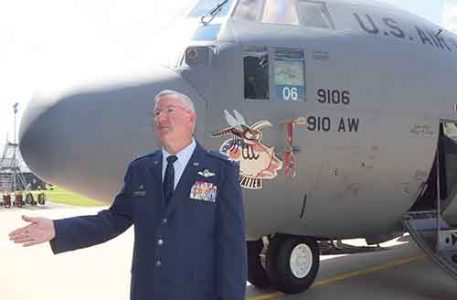
YOUNGSTOWN -- Col. Jeffrey Van Dootingh, commander of the 910th Airlift Wing at the Youngstown Air Reserve Station in Vienna, gave an overview Wednesday of the 2,000 military and civilian personnel who make up the reserve station -- making it the largest employer in Trumbull County.
He spoke at a meeting of the Rotary Club of Youngstown at the Wick Park Pavilion on Youngstown's North Side.
Van Dootingh, who became commander in June, addressed the upgrades coming to the base and the possibilities for getting new aircraft. But among the more interesting observations he made was regarding the aerial spray mission at the air reserve station.
"Anyone interested in military history will know that throughout mankind, more military combatants have died from disease than actual combat wounds," he said.
"What we can do with our aerial spray mission is, we can protect our troops from disease-carrying insects so they are healthy and can get in the fight and do the mission they were sent there to do -- and not in a hospital with some sort of disease," he said.
Van Dootingh was among the reservists who flew C-130s in missions over Louisiana and Texas in 2005, spraying 2.9 million acres to control mosquitoes and filth flies in the aftermath of Hurricane Katrina.
It was the largest aerial spray mission ever conducted by the Air Force Reserve Command, according to the air reserve station's website.
Van Dootingh said it was special to fly those missions because the linemen restoring power in those areas were grateful.
"They were getting up to 200 (mosquito) bites per minute," he said of the linemen. "After we sprayed, they were getting one or two," he said. "I loved that mission because we got immediate feedback."
Van Dootingh said such spraying has two benefits: It assists the people working in an area with pest insects, "but we even prevent diseases from even starting because we take the mosquitoes and filth flies out before they even get to start spreading disease."
He also flew into New Orleans, he said.
"We flew into downtown, right between the big skyscrapers and took care of the potential disease-carrying insects," he said.
The 910th Airlift Wing has the Department of Defense's only large area fixed-wing aerial spray capability.
In addition to controlling disease-carrying pest insects, the wing can control undesirable vegetation and disperse oil spills in large bodies of water.
In May and June 2010, the Airlift Wing's 757th Airlift Squadron from Vienna conducted aerial spray for Operation Deep Horizon.The squadron used oil-dispersing agents to neutralize the oil spill caused by the April 2010 sinking of the Deepwater Horizon drilling platform in the Gulf of Mexico. The 910th Airlift Wing flew missions covering 30,000 acres over water.
"We went in and sprayed, and it really reduced the harmful effects on the environment," Van Dootingh said. It turns the oil into a substance that can be eliminated naturally in the ocean. "It becomes biodegradable. What a giant brain to come up with that," he said.
Van Dootingh amassed more than 420 combat flying hours in Panama, Southwest Asia and the Balkans, including the first C-130 mission into northern Iraq at the onset of Operation Iraqi Freedom, according to his biography.