
Warren council considers solar power
Council looks at panels to power energy future
Trending
WARREN -- A plan to power the city's main fire station and the city's municipal building -- which houses the police department, council chambers and municipal court -- primarily with solar power will be unveiled during Tuesday's 4 p.m. city council utilities meeting.
Councilman Greg Greathouse, D-3rd Ward, wants to push the city into the future by establishing a solar farm or array on South Street, across from the city's main fire station, that would provide the power needed to operate the station as well as the city's municipal building.
If the city wants to make a greater investment into using solar energy to power its buildings, it also could demolish 418 S. Main Ave. and the parking area behind it to expand the proposed solar array, so it could provide electricity to the city's environmental services building and operations department.
Any excess power generated could be sold to other entities, such as Trumbull County, to provide power to the Juvenile Justice Center, according to Greathouse.
The councilman emphasized it would be easy for the city to have solar panels placed on the 3.23-acre property south of South Street because it already owns the land and there are no buildings on it.
There is enough land to place sufficient solar panels to create 0.5 to 0.6 megawatts of electrical energy, which is enough to power the fire station and the municipal building, according to Greathouse.
Once the panels are placed, Greathouse said lines will be placed to connect them to the city's main fire station, 111 South St., and then to 141 South St., which is the city-owned municipal building.
Greathouse said he eventually wants to place a solar farm on 41 acres comprised of the former Westlawn property and the Warren City School District-owned Western Reserve property on the southwest side of the city.
"This could provide enough energy to provide power to all of the city's buildings," he said.
The problem with using the Westlawn / Western Reserve properties is the city will have to pay Ohio Edison to provide lines to transport the electricity to all of the city buildings, he said.
Greathouse said he already has spoken to Safety Service Director Eddie Colbert, Mayor Doug Franklin, and auditor Vincent Flask about the possibility of doing this project. He also has had conversations with individual council members about the project.
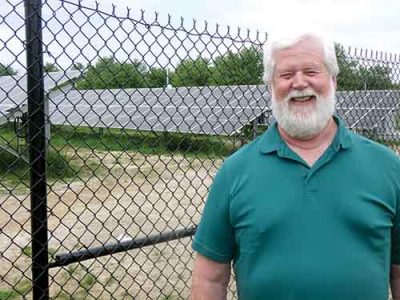
Colbert, Flask and Councilman John Brown, D-at-Large, were taken to see similar solar project on the Kent State University at Trumbull campus. KSU has solar farms on each of its regional campuses.
The Trumbull solar array will provide clean energy representing about 65 percent of campus use.
Kent State University and Ten Nine Energy agreed to a 25-year power purchase agreement. In return for purchasing solar power, Kent State campuses pay no out-of-pocket expenses for the panels and installation.
It is estimated that the campus will save more than $24,000 the first year and more than $1.3 million over 25 years.
Franklin last month pledged to cut the city's carbon emissions by 30 percent by 2030 when the city joined the nonpartisan Power A Clean Future Ohio.
At the time, Franklin described 30 percent being an ambitious goal, but added that moving to a cleaner energy production will create new jobs.
Colbert said the administration is interested in the proposal being presented, adding this is one avenue that can be explored to reduce energy consumption while generating savings.
The city also is looking at ways to eliminate waste by providing better insulation in buildings, newer roofing systems, replacing windows and purchasing energy-saving equipment.
"Some people say you should do these types of things first, before doing solar projects, so you will know your true energy consumption," Colbert said. "All of these things are worthy of discussion."
Councilman Ronald White, D-7th Ward, said he is willing to listen to the presentation, but he does not want to move too quickly.
"These are our emergency services buildings," White said. "We want to make sure they always have the power to do the work our citizens deserve. There must be back-up systems in case there are problems."
Dan Cook, of Solar Stone Energy LLC, will be making the presentation about the solar project to city council at 4 p.m. Tuesday in council chambers.
"I want this to be done at no cost to the city," Greathouse said. "It has to save the city money and I want a turnkey operation. I don't want the city to design it, own it, build it and operate it."
There are a number of ways to pay for this project, including:
• The city purchasing the equipment upfront and operating the system;
• Having a vendor do all of of the initial investment, including purchasing the solar panels for the farm, setting it up, operating it and maintaining it.
"Under the second scenario, the city would guarantee buying power from the vendor for 20 to 25 years," Cook said. "It would receive power at a reduced price and the vendor would have an established customer for that time period."
The community has the option to purchase the equipment from the vendor after five years and / or an agreed number of years later.
Cliff Wood, owner of Prairie Wind Group, said his company helped to develop a project for Cuyahoga County that placed solar panels on top of the closed Brooklyn Landfill, which provides power for 16 county-owned buildings.
The county purchases power from Cleveland Public Power, the city-owned electric company. This solar project began operating in 2019.
The four-megawatt solar array consists of 35,520 panels and was built by Columbus-based IGS Solar on about 17 acres of the closed 75-acre landfill. The solar array provides about 5 percent of the county buildings' electricity needs.
It is projected to save the county up to $3 million on utility bills over the next 25 years.
Michael Foley, director of sustainability for Cuyahoga County, expressed support for this type of project designed to reduce a community's carbon footprint.
"The county has committed to reducing its impact on greenhouse gases on the climate," Foley said. "We are working on normalizing the use of renewable energy."
In each of its programs, Foley said Cuyahoga County projected to save millions of dollars over a 25-year period due to the lower cost of electricity it is projected to use.
"This is a win-win," Foley said. "We are reducing the greenhouse emissions, area workers are being provided jobs as they are putting in these panels, and we're paying less for electricity."
rsmith@tribtoday.com