
Warren closer to St. Joe’s demo
Administration expects $2.5M grant to remove asbestos at ex-hospital
Trending
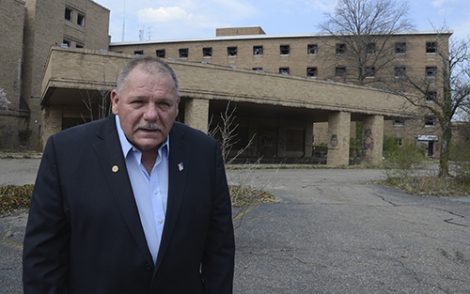
WARREN -- It's been three decades coming, but Warren Mayor Doug Franklin says a northwest neighborhood blighted with the dangerous, decrepit "eyesore" of the former St. Joseph Riverside Hospital may see relief soon.
Franklin said he is confident a $2.5 million grant application for asbestos abatement at the hospital will be awarded next month. Franklin and several city officials and council members gathered Thursday afternoon on the steps of Warren City Hall, where council members signed a request-for-legislation document expected to be voted on Wednesday, authorizing the administration to apply for the funds through the Ohio Development Services Agency.
The city doesn't expect to find out if it will get the funds to remove the asbestos from the building until May.
"We're pretty confident that we'll be awarded this grant," Franklin said.
The biggest barrier to razing the building has been the asbestos abatement, Franklin said.
Michael Keys, director of community development for the city, said if the funds are granted, the asbestos mitigation probably will begin this year, enabling demolition in 2022.
If the funds are awarded, the city will go through a bid process to find a contractor.
The demolition and asbestos abatement are expected to cost a total of $5 million, Keys said. Although funds have not been secured yet, Franklin said the city is pursuing multiple options.
"We're looking at other grant sources to accomplish that. I've been in a lot of talks with the auditor, so we're looking at a variety of ways to obtain that money to get that demolition started next year," Franklin said.
When asked if special funds awarded because of the pandemic would be used for the project, Franklin said the city hasn't planned on using that money and officials first will explore other opportunities.
The area, once free of the building, will be transferred to the city and transformed into a greenspace first, Franklin said. Then community input will be accepted to determine its use in the future. Franklin said he expects the space to be filled with something suitable for a residential area, like a park or maybe housing, but nothing is concrete.
Councilman John Brown, D-at Large, said having the space returned to a green area will assist the city in its efforts to make the river a "focal point."
"After accepting the $3 million through Eastgate (Regional Council of Governments) last month to remove the dam (near the Summit Street bridge), and a grant for a kayak dock across from it, we are looking at this as 15 more acres of green space for the city," Brown said. "It will increase development of recreational access to the Mahoning River."
The former hospital was developed in 1934, with additions added in later years. When the hospital moved to Eastland Avenue in 1995, the hospital changed hands several times before Euro-American Finance Network took possession of the empty building in 2010. After several failed attempts to contact the owners, the city condemned the property in 2012.
Although a suit was filed against the company, "the litigation did not bear results as the company is basically an empty shell corporation with no assets" to pay for the asbestos remediation and demolition, states a history of the property prepared by city officials.
In 2015, a tax foreclosure was filed by the county and it was placed into forfeiture. An Environmental Assessment Grant was used by the Trumbull County Brownfield Coalition to conduct an asbestos assessment.
In 2020, the Ohio Environmental Protection Agency granted applications for a two-phase environmental assessment of the site, completing the second phase earlier this year.
Franklin said the work of the past, though sometimes frustrating, paved the way for recent steps moving closer to demolition. He said the people in the neighborhood and the nearby domestic violence shelter and veterans clinic have endured the "eyesore" for long enough.
Councilman Larry Larson, D-1st Ward, said few windows are left in the building and open elevator shafts make it "unsafe."
"As we all know, hospitals historically stabilize and add value to neighborhoods. Well, this hospital over the last 30 years has done the opposite. It has driven down property values, and it's created an eyesore they have to look at every single day," Franklin said.