
Fairgrounds traffic to get rerouted
Mud issues on pathways to be solved as county awaits costs on vaccination building
Trending
WARREN -- It appears rerouting traffic at the drive-thru vaccine clinic at the Trumbull County Fairgrounds will solve the problem of soggy pathways at the site, according to Trumbull County Commissioner Mauro Cantalamessa.
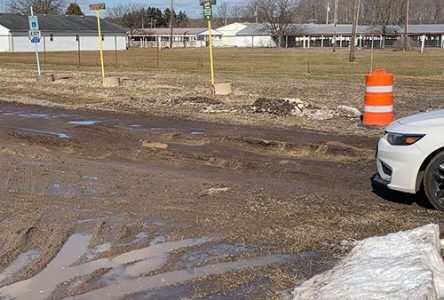
When the temperatures warmed up, the ground began to thaw and the vehicle paths at the vaccination site grew rutty and muddy. Some vehicles were bottoming out as they moved through the line.
"The parking lots were not designed to be driven on all winter long. With the frost, thaw, freeze, thaw process, the ground is soft and mushy. (Thursday) we had 1,448 come through. We monitored it, and when it became too soft, we moved them to another lane. It was nice to have the extra help from the sheriff's office and the fair board members. They directed traffic to keep it moving. We have a lot of people working together to conquer this thing," Bud Rodgers, fair board president, said.
Members of the fair board and other officials facilitating the vaccine site reached out to county commissioners to figure out a solution. Jim Misocky, the commissioners' administrator of special projects, asked Trumbull County Engineer Randy Smith's office to look into using asphalt grindings to cover the pathways.
"The vehicle pathways between the fair office building and the old fire station are damaged beyond the simple fix of applying asphalt grindings to the driving surface. If grindings were to be applied to this area, the pathways would quickly revert to the existing conditions with mud pumping to the surface," states a Friday letter from Tom Klejka, the engineer's highway superintendent, to Misocky. "Now that the area is severely rutted, the only sustainable fix is excavation and replacement."
At $19.50 per ton, it would cost around $114,000 for enough grindings to cover a 16-foot-wide, 4,945-foot-long pathway to a depth of 12 inches -- 5,860 tons -- the letter states. If other pathways also received an application of 3 to 4 inches of material, it would cost an additional $64,000 in grindings, the letter states. There also would be an expense for the excavation of the ground.
Instead of spending money to improve these routes, Cantalamessa said rerouting traffic makes more sense.
"When the drive-thru first started, the pathways were basically going through the grass. There was snow, and it was frozen, so it was fine. Now that it is thawing, the ground is softer. So, we will reroute the traffic to go down the midway, so the traffic is staying on hard surfaces the whole time," Cantalamessa said.
Trumbull County sheriff's deputies will be available to direct traffic, the vaccination tent will be moved and some signs will be added, Cantalamessa said.
Traffic will come in through Bazetta Road and stay on the length of the hard surface on the midway, which can accommodate two or three lanes of traffic, he said. There is a hard surface area that will be used for those who received the vaccine to wait before leaving. The plan could affect Durst Clagg Road traffic, but it will remain open with deputies assisting, Cantalamessa said. Few cars travel on the road daily.
Cantalamessa said spending hundreds of thousands on the paving would push the costs of upgrades at the fairgrounds for the drive-thru clinic too high.
Commissioners next week are expected to receive proposals spelling out the total costs for a structure at the fairgrounds to conduct the vaccines. A tent is being used now.
Initial proposals indicate the costs should be less than $400,000. Commissioners have not put their final stamp of approval on building the structure, but two of the three commissioners -- Cantalamessa and Frank Fuda -- voted to support the project. Commissioner Niki Frenchko does not support the project. Frenchko said she thinks other alternatives to the building should be pursued.
The structure itself was selected through a government purchasing site called Source Well, said Jack Simon, a Trumbull County Combined Health District board member working on the project. Because it is a competitive purchasing cooperative, it can substitute for competitive bidding, Simon said. Through the resource, officials found the deal for the structure with the Lisbon company We Cover. The cost will cover the structure, the materials inside like the amp box and heating system and the labor to build it.
Separately, Simon is working to assemble local cost proposals for the excavation of the site and the utility hookups.
Five cost proposals have come in for the excavation, and all but one is less than $50,000, so that portion of the project likely can be awarded without bidding, Simon said. The utility hookup is expected to cost even less, probably less than $5,000, he said.
If commissioners approve the spending using CARES Act funding, as proposed, the federal prevailing wage will be used to pay the union workers, as federal spending guidelines dictate, Simon said.
Cantalamessa said commissioners will review the proposals for the other aspects of the project once submitted next week and discuss whether the spending can be done with proposals instead of a bid process. It may take another week to review with the prosecutor's office, he said.
A bid process would extend the time it takes to get the building started, as packets would have to be developed and the bid process would be open for three weeks, Simon said.
It's expected to take up to eight weeks to construct once it gets the go ahead to move forward.
Frenchko said she doesn't support the project, but if Fuda and Cantalamessa move forward with it, she hopes they have the total, real costs of the project at hand first.
"Who is handling the site preparation, for how much? Who will pay for the utility costs, not just the connections, but the monthly cost? What about insurance for the building? And building maintenance in the future? What are the total costs? Should there be a bid process? The public deserves to know this information before Frank and Mauro approve it," Frenchko said.