
Warren veteran Ed Piper saved POWs
Trending
WARREN -- Ed Piper, 83, of Warren admits he has lived an interesting life. With five marriages and a myriad of unusual jobs working all over the country, he has many stories to tell -- but for most of his life he had to keep secret his most unusual story of all.
When Piper turned 18 in September 1955, he dropped out of his high school in Beaver, Pa., and three days later signed up for the U.S. Navy. Tuesday, he was honored with a Vietnam Veteran's pin from the Daughters of the American Revolution during a Veterans Day ceremony at the Butler Veterans Affairs -- though Piper never served in Vietnam. He did not serve in the Korean War either, and he was honorably discharged from the Navy with just a month of service. Still, Piper's back bears the shrapnel scars that tell of his forgotten service in a time between wars.
After enlisting in the Navy, Piper was sent to Great Lakes, Ill., in October 1955, where on his second day he underwent a battery of tests.
"I didn't know this at the time, but one of them was an IQ test," Piper said.
The next day, a physician failed Piper's physical, though he had passed an earlier exam in Pittsburgh. A few days more found Piper in the office of the camp commander.
'I KNOW YOU'
"He said, 'I know you.' I said, 'I don't know you, sir.' In the next 15 minutes, he told me everything about my life, clear back to the day I was born in old Massachusetts," Piper said.
Piper was set to be sent home with a medical discharge, but the commander said he could change it to an honorable discharge if Piper would hear him out.
"He said, 'There's one thing I want you to understand. What we discuss from here on in this office today, never leaves this office.'"
The commander went on to explain that a team of 50 men -- five teams of 10 --was being assembled to go into North Korea to extract American prisoners of war and search for those missing in action. The Korean War officially had ended in 1953.
Eighteen-year-old Piper signed on then and there.
He was given his honorable discharge and instructions to see a woman at the Butler unemployment office. She gave him a job as a surveyor, which he worked until February 1956.
"The job in Butler was the beginning of my cover, but I didn't understand all that. I didn't understand anything about surveying either, but I was going to work on a survey crew," Piper said.
Then, Piper got a call. He would be "working" for Michael Baker Jr. Engineering Firm in Beaver Falls, Pa. -- a company that did a lot of work overseas. He was assigned to a yearlong job in London, but reported to Bethesda, Md., for four weeks of training under South Korean armed forces personnel.
"We didn't go through the normal boot camp. We were going through a specific training for where we were going and what we were going to do," Piper said. "We never had anything to do with any American troops there. We were isolated from them completely."
INSIDE THE NORTH
With three weeks of survival training and one week of arms training under his belt, Piper with nine other American men and one South Korean interpreter were sent to North Korea.
In 11 months, Piper's 11-man team rescued 87 men and destroyed 17 prisoner camps.
North Koreans "were holding these men, just using them for slave labor basically. We found anywhere from three to eight men captive in those camps. The objective was to destroy the camp completely and rescue what we can."
The team also identified seven American graves.
Piper said at first the experience felt like a circus, but after three weeks and finding the first camp, the men realized for what they'd signed up.
About halfway through Piper's service, one of his men stepped on a land mine that was set to explode when he moved his foot.
"I said, 'Alright, throw off everything you've got on you, your rifle, everything. I want nothing but you and your clothes,'" Piper said.
He handed his man the end of a 12-foot branch and told him to put a "death grip" on it. When they were both ready, Piper pulled him away from the mine. They were both riddled with shrapnel.
The incident earned Piper his scars, which he never talked about until about seven years ago, when his wife at the time, Mary, drew the story out of him.
Following the explosion, two old Korean women picked the shrapnel from Piper and the other man. The other man was taken away, while the women wrapped Piper in wet tea leaves and muslin and left him to heal for eight days. Then, the women told Piper, "You good. Put on shirt. Go," he said.
"They wanted us out of there because if we'd got caught there the North Koreans would have destroyed the whole village because they were protecting us."
Piper later found out the other man lost the bottom part of a leg, but lived.
When his 11 months were up, Piper returned to Pennsylvania and began actually working for Michael Baker Jr. Engineering, surveying what would become Interstate 80. He held a series of other jobs thereafter, from selling cars to driving tractor-trailers and operating heavy equipment.
Until recently, Piper and the other men who went to North Korea "didn't exist."
"We were told, if you're captured, we don't know you. We don't know who you are; we don't know where you came from; we don't know what you're doing there. The South Korean military will do everything they can to get you out. If you're killed over there, the South Korean military will do everything they can to recover your remains. But that was it. We were basically guerillas," Piper said.
Piper said he never knew the men he served with, except by their first names.
When he sent letters home to his mother, they arrived in the U.S. postmarked from London, England.
PAYROLL TRAIL
Only recently did Piper's story come to light, after a man at the Butler Veterans Affairs office tracked him down by following a trail of old military payroll records that showed money paid to civilians. Piper made $89 per month for his service, $20 more than the base military pay at the time.
Piper says he has no regrets in life.
"I have lived coast to coast and border to border. I have lived and worked in 14 different states. I can't think of one thing in life I need to do. I've done it all," Piper said.
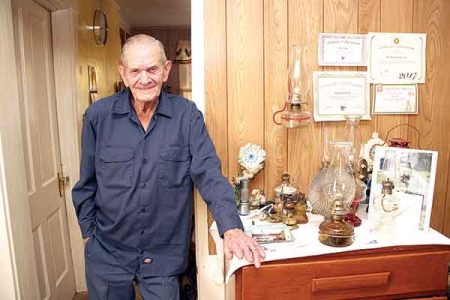
Piper buried Mary, his wife of 28 years, in August 2017 after she died of a stroke that June. He keeps himself busy making trips to the Butler VA office and visiting with an ex-wife who lives in the area. He also restores antique oil lamps. Piper recently acquired 85 lamps at a garage sale in Niles, and has been getting them ready to donate to area museums and historic homes, where they will be preserved.
In the kitchen of his Warren home, Piper has a framed certificate from a Virginia chapter of the Daughters of the American Revolution, who in October thanked Piper for his service with the 50th anniversary of the Vietnam War commemorative lapel pin, which is given to anyone who served on active duty, regardless of location, between Nov. 1, 1955, and May 15, 1957. The DAR found out about Piper's service from his son, who lives in Virginia.
He said the type of work he did in North Korea goes on to this day.
"And I would do it again tomorrow if I was able," Piper said. "I've never regretted it. If you had seen some of the men we brought out, you would understand."
news@tribtoday.com