
Annual ceremony remembers locals lost in Vietnam
Annual ceremony remembers locals lost in Vietnam
Trending
YOUNGSTOWN -- James Lemmon recalled that his older brother, Richard K. Lemmon, won many hearts not by performing any great feats for others, but merely because of the small acts of kindness he showed.
"He was always a person who wanted to help everybody. He was well-liked and liked to do for others," Lemmon, of Boardman, remembered. "He did a lot of little things and would help you with your problem, no big gesture."
Perhaps the elder Lemmon's biggest gesture, however, was the decision to serve his country in the U.S. Army during the Vietnam War after having given up a deferment to be with family, then being drafted, James explained.
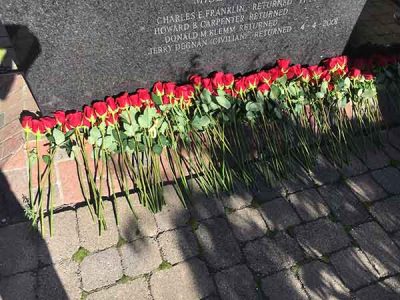
Richard Lemmon also was one of the 100 Mahoning County soldiers killed during the Vietnam War and honored during the annual Laying of the Roses ceremony Sunday afternoon at the Vietnam War Memorial in downtown Youngstown.
Hosting the somber 90-minute program was the Mahoning County Veterans Service Commission.
The emotional gathering was to honor the fallen soldiers, as well as prisoners of war and those missing in action, for their sacrifices and service, Brian Kennedy, an Iraq War veteran and Mahoning County VSC commissioner, said.
Before being drafted into the military, Lemmon, who was killed April 12, 1969, at age 23, attended DeVry Technical Institute near Chicago and was working in the field of radar, but got homesick and returned to the Mahoning Valley. He was shipped to Vietnam soon after having completed boot camp in late 1968, James Lemmon said.
"I can remember when he was leaving and came to the door for the last time and said goodbye," James recalled. "I had the feeling I wouldn't see him again; I just had that feeling in the pit of my stomach when he was going away."
The event's keynote speaker was Youngstown Mayor Jamael Tito Brown, who praised Leo H. Connelly Jr., a decorated veteran who served two years in the Army in the 1960s, for further educating him regarding those who have served the nation.
Brown mentioned three cousins who served in the Armed Forces for a variety of reasons, one of whom was looking for a greater life challenge.
Another relative made a series of poor decisions and, after ending up in court, was offered an ultimatum, Brown remembered.
"The judge said, 'Son, you have two options: jail or go into the military,'" the mayor said, adding that the cousin served four years in the Army, received an honorable discharge and made a success of his life.
The cousin who was seeking a higher challenge joined the Marine Corps soon after high school and retired after having served 24 years in the military. Another enlisted in the Marines at age 24 because he felt it was time for him "to grow up," Brown continued.
"I didn't think he was going to make it until I was invited to his graduation," Brown said of the cousin who joined the military at 24.
Family members, relatives or fellow comrades placed one red rose next to the Vietnam War Memorial for each of the 100 fallen soldiers as their names were read aloud and a bell was rung. Some wiped away tears while saluting the memorial and touching the names of their loved ones inscribed on it.
Barry Jones of Poland left a rose for Abron E. Davis, who served in the Marine Corps. He didn't know Davis but drew his name, though Jones went to school with James H. Spencer, another of the 100 fallen soldiers, he said.
Also at the gathering was an empty chair on which were a cover and a single red rose with a yellow ribbon tied to it -- all symbolic of a missing soldier's sacrifice and plight.
The chair recognized soldiers who are unable to be with family and loves ones, as well as the frailty of one POW against oppression. The cover represented the fact that such comrades are always present in spirit; the rose symbolized the blood sacrificed and the ribbon was a metaphor for the determination to provide an accounting of all those still missing.
Gail Lemmon never met her brother-in-law, Richard Lemmon, but learned he was someone others looked up to and was grateful to serve his country, she explained.
"That is the least we can do for these brave people," she said about her main reason for attending the program every year.
news@tribtoday.com