
World War II vet ‘mopped up’ in Europe
Trending
BROOKFIELD -- Anthony Yassall spent a large portion of World War II as a teen in Sharon, Pa., watching all the other young men ship off to fight the good fight.
And he wasn't happy about it.
Three days after D-Day, June 6, 1944, Yassall turned 18 and signed up for the draft. Unlike others he knew who didn't want their draft card, Yassall couldn't wait and took it proudly.
"I didn't want a deferment. I was younger, so everyone was gone already, everyone was there," Yassall said.
By Sept. 5, he was drafted and was soon off to South Carolina for basic training in the U.S. Army. After a stop at a camp in New York, Yassall found himself on a four-day voyage across the Atlantic to Liverpool, England, then went on to South Hampton before arriving in Luxembourg City, just months after the city's small country was liberated by the Allies from German control.
From there, Yassall and the rest of the 5th Infantry, spread through the European Theatre "mopping up" after the other troops, until they made it into Germany.
"We took the high ground and slept in a stone quarry. In the morning, it was foggy, and we started moving into an open field. We were digging in and halfway through the field, the fog lifted and that is when the tanks came out," Yassall said.
The troops started "bunching up" and moments after Yassall told his buddy, "'We better leave, the shells are coming," they struck.
"No sooner than when I said that, one hit 5 feet away. It tore the sleeve of my jacket. It hit me in the hip," Yassall said.
"I should have been dead."
It took six, maybe seven hours to get out of there after Yassall was struck, he said.
"They blew up the bridge behind us," he said. "It hurt, but I crawled up to a medic, behind some rocks. He said, 'I'll come back for you, we're making a run for the high ground. Wait here, I'll come back.' I said, 'No way. You're not leaving me here.' I made it."
Once they made it to an aid station, it too was struck by rockets.
"That war was hell," Yassall said.
Yassall spent 56 days recovering in a hospital.
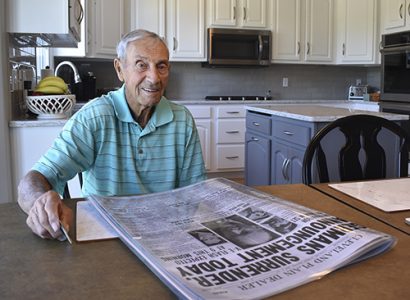
A day later, Germany surrendered.
Yassall spent the next few months away from battle, repairing rail cars before going on guard duty. His sister sent letters; his mother said the Rosary "every day."
Before the injury that earned him a Purple Heart, Yassall and the other men slept outside in the field, digging foxholes for protection. During one combat patrol mission, they dug in and laid logs over themselves to protect the men from debris raining down from the shells. The opposing troops went right around them, not realizing the men were hidden underneath, Yassall said.
They survived on K-Rations, when they were available -- a can of "something," crackers and four cigarettes, Yassall said. "Sometimes, we didn't even have that."
At times, Yassall and the other men were guarding civilians in the countryside. Although they couldn't communicate without a common language, they found ways to act out their intentions.
"Once, during a shelling, they motioned to us to go out and get firewood. We knew what they meant when they started burning furniture. We weren't going out there. But we knew what they meant," Yassall said.
After coming home, Yassall met a woman, Shirley, during a blind date on New Year's Eve in 1950. They've been married for 67 years and had four children, Gail, Bonnie, Rhonda and Paul.
Yassall worked 42 years for the railroad, including the Erie Railroad, Erie Lackawanna Railway and Conrail, and operated a family farm in Brookfield.
Yassall said when it comes to war, the politicians sending troops to fight should be "put in a ring to let them fight it out themselves" because "war is hell."