
Birds flock to Mosquito Lake
May begins prothonotary warbler season
Trending
BAZETTA -- With climbing numbers of nesting birds, Mosquito Creek Lake is an avian haven -- and a great place for watching, counting and learning about birds.
Loyd Marshall of Gustavus takes an interest in a particular bird that makes its summer home at the lake -- the prothonotary warbler. For the past 10 years, Marshall has helped monitor the population of the small, "friendly" yellow birds.
"I'm doing it for the birds, but I also want to get the birds recognition," Marshall said.
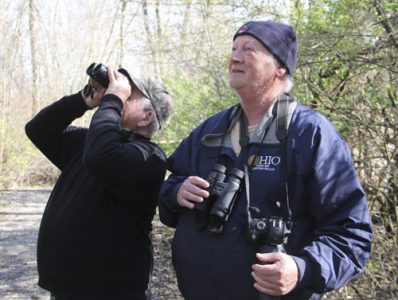
Marshall said the lake attracts a variety of bird enthusiasts from casual bird watchers, who may just enjoy watching their backyard birds, to serious birders who identify species and keep counts to submit to bird tracking websites.
"I'm not a serious birder because I don't keep lists," Marshall said. "What I do is more conservation. It's a lonely sport."
Starting in May, Marshall and fellow volunteer Steve Craiger monitor 19 jars around the lake, about three fourths of which usually become occupied with nesting pairs of prothonotaries. Two of the jars can be seen easily from the viewing platform on the nature trail at the Lakeview recreation area at 3061 Warren Meadville Road.
This past Saturday, Marshall ran into birder Rick Nelson of Howland on the nature trail. Nelson, who keeps count of all the species he identifies, said he had seen 37 types of birds that morning, including a number of different warblers. Nelson said just fewer than 40 types of warblers pass through Ohio, with about 20 nesting, and a dozen of those are found at Mosquito Lake.
Of the warblers at the lake, the prothonotaries are the only ones that are cavity nesters, meaning they build their nests in enclosed spaces such as holes in trees, birdhouses or Marshall's jars.
THE WARBLERS
The prothonotaries nest at Mosquito Lake from late April to early August, drawn to the swampy, shady habitat. For the winter, the birds travel 3,600 miles on an indirect path down the east coast to Florida and then to Colombia.
The male birds arrive back in Ohio first and build "dummy nests," but the females ultimately choose the nesting spot, Marshall said.
Marshall wades out into the water where the nesting jars stand on posts and opens them to check nests, eggs and fledglings. If the adult birds are in the jar, they fly off and return as soon as Marshall is gone.
In 2011, fewer than 10 fledglings were recorded, while in 2019 more than 80 prothonotary warblers fledged, according to Marshall's data.
Marshall said he started learning about the prothonotaries when he retired and became a volunteer with the Army Corps of Engineers at Mosquito Lake.
"I was an engineer," he said of his life before conservation. "I always had an interest in the outdoors."
When Marshall started volunteering at the lake, he was an eagle nest watcher. Marshall and other volunteers monitored the birds' behaviors and watched the nests for babies as part of a program run by the Ohio Department of Natural Resources.
Now, volunteers are not needed as nests can be monitored with technology, so Marshall directs his efforts toward the prothonotaries and enjoys other cavity nesting birds such as bluebirds, tree swallows and chickadees.
OTHER BIRDS
"This area has a great birdwatching community and it's mostly to do with the Mosquito Creek corridor," said Bill Spring, resource manager with the Mosquito Creek Lake Army Corps of Engineers.
The Mosquito Creek Corridor extends from the 9,000-acre Mosquito Creek Wildlife Area south along the creek to the mouth at the Mahoning River in Niles. The wooded corridor and floodplain encompass approximately 870 acres. Many birds use the area during migration.
According to the National Audubon Society, the corridor and lake are home to bird species including wood thrush, scarlet tanager, cerulean warbler, blue-winged warbler and ovenbird.
Nelson said local birders have identified almost 300 species in Trumbull County.
Gourds hung in the field south of the recreation area parking lot serve as homes for purple martins, birds that are very dependent on man for their housing. Volunteers also monitor the martins.
Not far up the road, in the parking lot of the former Delphi building in Cortland, osprey -- large, fish-eating birds -- have made a nest at the top of a lamp post.
BALD EAGLES
Another birdwatcher favorite, the bald eagle, also has flourished at Mosquito Lake.
In a recent survey by citizen scientists, Trumbull County was found to have the fourth-highest bald eagle population in the state -- 26 nests -- behind Ottawa, Sandusky and Erie counties. Counties situated along or near Lake Erie have the highest number of bald eagles because the lake provides an abundance of food and nesting habitat, according to the Ohio Department of Natural Resources.
Eagles nesting at Mosquito Lake take advantage of similar resources and a stable food chain.
"The level of resources and a diversity of resources are what make it such a suitable type of habitat," Spring said.
The bald eagle once was an endangered species, with only four nesting pairs in Ohio in 1979. Conservation efforts led to the species being taken off the endangered list, and the most recent count recorded more than 700 nests across the state.