
US expands attacks on Iran, which calls Strait of Hormuz a ‘red line’
Trending
DUBAI, United Arab Emirates -- The United States intensified its strikes against Iran on Thursday, hitting targets farther north and firing into a ship the U.S. accused of trying to break its naval blockade on the Islamic Republic. Iran retaliated by launching missiles and drones at U.S. allies in the region, and warned its attacks may escalate.
The interim ceasefire agreed to last month has collapsed, and the region has endured days of back-and-forth attacks by the U.S. and Iran as they battle for control of the Strait of Hormuz. Iranian officials say U.S. strikes have killed more than 35 people and wounded over 300 others.
For the first time in this latest round of violence, strikes also reached into areas around Iran's capital, Tehran, showing a widening set of targets for the Americans. The U.S. launched a second wave of strikes late Thursday, saying it was aiming to "further degrade" Iran's military capabilities.
When the U.S. and Israel launched the war on Iran on Feb. 28, Tehran effectively closed the strait to shipping traffic, a move that sent the price of oil soaring and gave Iran major leverage in negotiations.
Col. Ebrahim Zolfaghari, a spokesperson for the Iranian military's Khatam al-Anbiya Central Headquarters, threatened that Iran could launch widespread attacks on "all the infrastructure in the region" if the U.S. acts on President Donald Trump 's repeated warnings that America could hit Iranian bridges and power plants.
"Under no circumstances and in no way will we allow America, as a foreign and extraregional country, to interfere in the Strait of Hormuz," he added. "This is Iran's invincible red line."
Iranian state media said the U.S. strikes Thursday hit around Tehran and Semnan province, home to Iran's ballistic missile production and space program. State media also reported strikes around the provinces of Hamedan, Hormozgan, Khuzestan, Lorestan, Markazi, and Sistan and Baluchestan, as well as on Iran's Qeshm island, near the Strait of Hormuz.
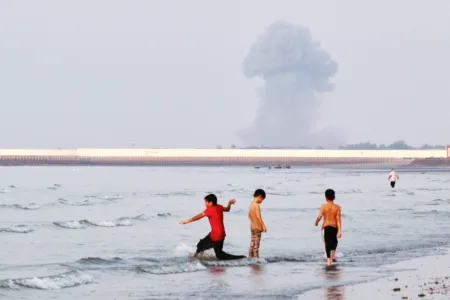
Seven people were wounded in a U.S. strike that hit the Allah-Akbar Hill residential neighborhood in the port city of Bandar Abbas, according to Iranian state media. Two more people were wounded in a U.S. attack on the Bandar Abbas railway junction station, state media said.
And just west of Bandar Abbas, witnesses reported that two bridges were struck in a U.S. attack, killing three people and wounding nine others, state media said.
An attack on Greater Tunb Island targeted Iranian defense and missile sites, U.S. Central Command said.
Greater Tunb Island is one of three small rocky islands that sit at the confluence of the Persian Gulf and the strait. The islands -- seized in 1971 by Iran from what would become the United Arab Emirates -- help the Islamic Republic exert significant control over the strait.
The U.S. military also said it disabled a Curacao-flagged oil tanker as it sailed toward Iran's main oil export terminal, firing a missile after the ship "ignored multiple warnings."
Another American strike Wednesday targeted a barracks for Iran's 388th Mechanized Infantry Brigade, which operates tanks and armored vehicles, in Sistan and Baluchestan province, Iranian state television reported. The report said seven were killed in the attack, including conscripts and career soldiers.
Iran retaliated Thursday with missile and drone attacks on Bahrain, Jordan and Kuwait, authorities in those countries home to U.S. forces said. There was no immediate acknowledgment of damage or casualties from the attacks.