
Iran talks end with no deal
US military says it will blockade ports
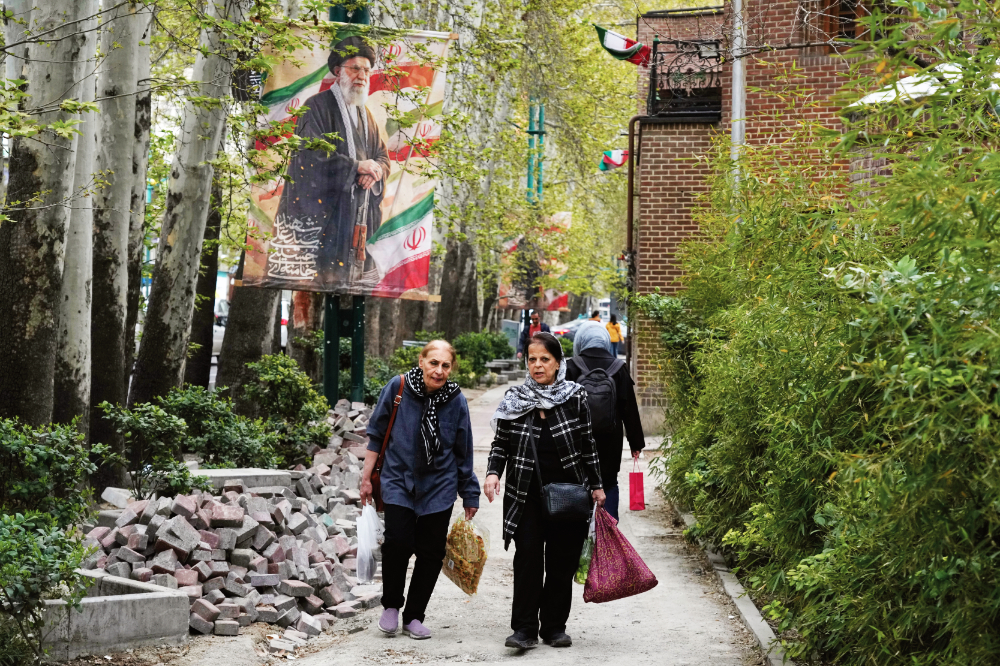
AP Women walk past a banner depicting the late Iranian Supreme Leader Ayatollah Ali Khamenei, who was killed in the U.S. and Israel strikes on Feb. 28, in northern Tehran, Iran, on Sunday.
ISLAMABAD– President Donald Trump on Sunday said the U.S. Navy would swiftly begin a blockade of ships entering or leaving the strategic Strait of Hormuz, after U.S.-Iran ceasefire talks in Pakistan ended without an agreement.
U.S. Central Command announced the blockade would involve all Iranian ports, beginning on Monday at 10 a.m. EDT, or 5:30 p.m. in Iran, to be “enforced impartially against vessels of all nations.”
However, CENTCOM said it would still allow ships traveling between non-Irani an ports to transit the strait. Its announcement was a step down from the president’s earlier threat to blockade the entire strait, and allows traffic to flow in the crucial waterway as long as it avoids Iranian ports.
Trump wants to weaken Iran’s key leverage in the war after demanding that it reopen the strait to global traffic on the waterway that was responsible for 20% of global oil shipping before fighting began.
That traffic has been limited even in the days since the ceasefire. Marine trackers say over 40 commercial ships have crossed since the start of the ceasefire.
A U.S. blockade could further rattle global energy markets.
Oil prices rose in early market trading on Sunday after the blockade announcement. The price of U.S. crude rose 8% to $104.24 a barrel, and Brent crude oil, the international standard, rose 7% to $102.29. Brent crude cost roughly $70 per barrel before the war in late February.
Iran’s Revolutionary Guard later said the strait remained under Iran’s “full control” and was open for non-military vessels, but military ones would get a “forceful response,” two semi-official Iranian news agencies reported.
During the 21-hour talks this weekend in Pakistan, the U.S. military said two destroyers had transited the strait ahead of mine-clearing work, a first since the war began. Iran denied it.
Trump’s plan to use the Navy to block the strait is unrealistic and he will have to concede on some issues with Iran, said Andreas Krieg, a senior lecturer in security studies at Kings College London. “There isn’t any tool in the toolbox in terms of the military lever that he could use to get his way,” Krieg said.
Trump said Tehran’s nuclear ambitions were at the core of the talks’ failure. In comments to Fox News, he again threatened to strike civilian infrastructure.
Iranian parliament speaker, Mohammad Bagher Qalibaf, who led Iran’s side in the talks, addressed Trump in a new statement on his return to Iran: “If you fight, we will fight.”
The face-to-face talks that ended early Sunday were the highest-level negotiations between the longtime rivals since the 1979 Islamic Revolution.
Neither indicated what will happen after the ceasefire expires on April 22.
“We need to see an affirmative commitment that they will not seek a nuclear weapon,” said Vice President JD Vance, leading the U.S. side.
Iranian negotiators could not agree to all U.S. “red lines,” said a U.S. official who spoke on condition of anonymity because they were not authorized to describe positions on the record. These included Iran never obtaining a nuclear weapon, ending uranium enrichment, dismantling major enrichment facilities and allowing retrieval of its highly enriched uranium, along with opening the Strait of Hormuz and ending funding for Hamas, Hezbollah and Houthi rebels.
Iranian officials said talks fell apart over two or three key issues, blaming what they called U.S. overreach. Qalibaf, who noted progress in negotiations, said it was time for the United States “to decide whether it can gain our trust or not.”
Pakistani Foreign Minister Ishaq Dar said his country will try to facilitate a new dialogue in the coming days. Iran said it was open to continuing dialogue, state-run IRNA news agency reported.
The European Union urged further diplomatic efforts. The foreign minister of Oman, located on the Strait of Hormuz’s southern coast, called for parties to “make painful concessions.”
International News
Irish PM announces fuel tax cuts to stop protests over soaring pump prices
LONDON — Irish Prime Minister Micheal Martin said Sunday that his government will offer new fuel tax cuts to try ...
Iran talks end with no deal
Russia,Ukraine accuse each other of violating ceasefire
KYIV, Ukraine — Russia and Ukraine accused each other of violating a Kremlin-declared Easter ceasefire Sunday, as ...
Israeli strike kills Lebanese security forces
Netanyahu OKs direct talks with Lebanon
DUBAI, United Arab Emirates — In a potential boost to Middle East ceasefire efforts, Israeli Prime Minister ...
Scientists discover the world’s oldest octopus fossil isn’t really an octopus
LONDON (AP) — A 300-million-year-old tentacled sea creature has lost its crown as the world’s oldest octopus, ...