
Trending
Declarer's first aim is to make his contract. At no time should the matter of potential overtricks influence his plays, since the value of a game, a slam or even a partscore far exceeds the value of an overtrick.
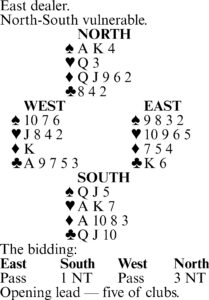
Consider today's deal where South is in three notrump and West leads a club. East takes the king and returns a club to West's ace. West continues with a club to South's queen, East discarding a spade. How should declarer proceed?
There is no doubt that many players would at this point cross to dummy with a heart or a spade, lead the queen of diamonds and finesse. If they did this, they would go down one after West took the king and cashed his clubs.
However, this line of play is contrary to the principle stated above. There is no harm in crossing to dummy and leading the queen of diamonds, but it is wrong to finesse. The right play, after East follows low, is for declarer to go up with the ace.
As it happens, the ace catches West's king and South winds up making five notrump, but the fact that the king falls does not in itself prove the play is right. There is a far better reason than hindsight for playing the ace.
Declarer should conclude that if East has the king, he will still make three notrump (with an overtrick) by continuing the suit after the ace fails to fell the king. But if West has the king, the contract can be saved if the king happens to be singleton. This latter possibility is something declarer is duty-bound to protect against.
Tomorrow: It's all in the details.