
Trending
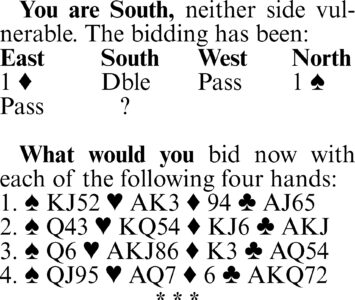
1. Two spades. Generally speaking, the double of one diamond shows at least an opening bid and implies support for the unbid suits. If the double is based on minimum values, the doubler should not bid again after his partner responds at the lowest level in his chosen suit.
Thus, if the doubler has 13 to 15 points, he should pass partner's forced response. If he raises partner's suit, he shows more than 15 points.
In this hand, the raise to two spades is justified by the 16 high-card points plus the doubleton diamond. Three spades would be a distinct overbid, since partner's one-spade response could be based on virtually nothing. Change the five of clubs to the king, and a raise to three spades would be justified.
2. One notrump. The rebid of one notrump after doubling indicates a hand that was too strong to overcall with one notrump initially. If partner -- who has thus far not promised anything -- does not act over this invitational rebid, the chances are there is no game.
3. Two hearts. Bidding a new suit after partner makes a minimal response to your takeout double shows a very good hand, usually 17-plus points as well as a strong suit. It urges partner to bid again but also allows him to pass with a bad hand. Unless partner can act voluntarily, game is unlikely.
4. Four spades. This is not the type of hand where partner should be consulted about the possibility of making game. It is not a question of how many points partner has, because even with a poor hand, he is likely to eke out 10 tricks.
Thus, if partner had just five spades to the ten and nothing else, he would probably lose only three tricks. To play him for less than that would be unduly pessimistic.
Tomorrow: Basic card-reading.