
Bridge by Steve Becker
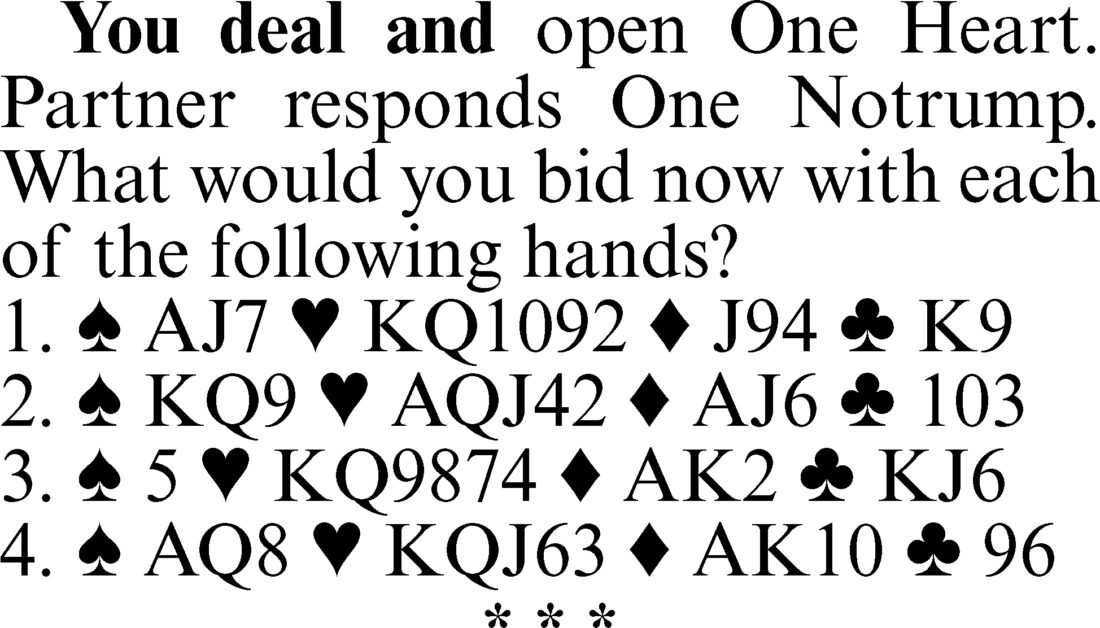
1. Partner’s one-notrump response shows six to 10 points, so you know immediately that the 26 points normally required for game are lacking. It might be tempting to bid two hearts, but that would not be the winning bid in the long run. This is a partscore hand, and the only question is whether one notrump will be easier to make than two hearts.
Granting that there are hands partner could hold where two hearts would be safer than one notrump, the fact remains that such hands are in the minority. Partner’s six to 10 points, added to your 14, should offer a good chance of producing seven tricks in notrump. The fact that you have an honor in every suit should also influence you to pass.
2. Two notrump. This is an invitational bid showing 16 to 18 points and a relatively balanced distribution. It asks partner to pass with six or seven points, but to carry on to three notrump with 9 or 10. With eight points, partner exercises his judgment.
3. Three hearts. This is also an invitational bid, but here the emphasis is on suit play rather than notrump. Partner should pass three hearts if he is in the lower end of the range for his notrump response. If he does pass, you are unlikely to miss a game.
4. Three notrump. With 19 high-card points facing at least six, you can’t afford to simply invite a game by bidding two notrump, since partner might pass.
Given partner’s failure to support hearts, three notrump is the obvious choice for game. An alternative possibility is to jump-shift to three diamonds (forcing to game), but this runs the risk of partner’s raising diamonds and could lead to disaster. Three notrump is the natural choice, and that’s what you should bid. Simplest is best.
Tomorrow: Between the devil and the D.B.S.
Lifestyles
Dear Annie: Neighbor’s bright light leads to sleepless nights
DEAR ANNIE: My neighbor “Rod” installed a motion-activated floodlight that shines directly into our bedroom ...
Senior news
THE GATHERING PLACE: The Gathering Place Senior Center at Lord of Life Lutheran Church, 550 N. Broad St., Canfield, ...
Bridge by Steve Becker
Seniors’ basic need to socialize
Just like food and shelter, human beings of any age need to socialize for mental health and physical health. This ...
Bridge by Steve Becker
It is said that in the long run, good bidding is more important than good card play. This is probably true enough, ...
Dear Annie: Standing firm when your family is divided
Dear Annie: Hopefully you can help me. I’ve read your column for years. My two kids are adults and have kids of ...