
Bridge by Steve Becker
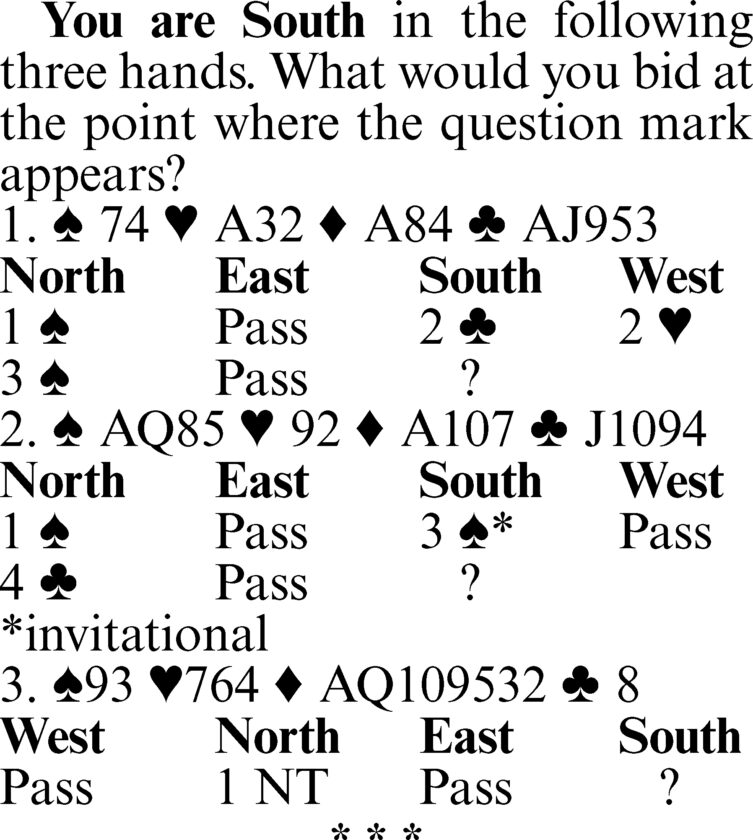
1. Six spades. There is the distinct aura of a slam when partner opens one spade and next jumps to three spades without knowing you have three aces. The one thing certain is that you should not stop short of six.
Alternatively, you could bid four hearts — a cuebid of West’s suit to suggest the possibility of a grand slam as you wend your way to six spades. Partner could have either of these two hands for his three-spade bid:
and six spades is odds-on to make on both.
2. Four diamonds. Partner’s four-club bid is a slam try; if he was interested only in game, he would have bid four spades. Since you have the ace of diamonds and about as good a hand as you could be expected to have, you must cooperate with partner by bidding four diamonds. Partner could have either of these hands:
and you would certainly want to be in six spades in both cases.
3. Three notrump. It’s true that you have only six high-card points, that you don’t have notrump distribution and that declarer ordinarily needs 26 points or more to have a good play for three notrump. Nevertheless, the winning bid is three notrump because the odds heavily favor making that contract.
In hands of this type, where there’s an excellent chance you’re starting partner off with seven diamond tricks, you can well afford to short-change him in high-card points because you have lots of tricks to take their place. You shouldn’t bet your life that partner will make three notrump, but over the long haul you’ll gain much more than you’ll lose by leaping directly to the notrump game.
Tomorrow: Let’s find out where we stand.
Lifestyles
Hints from Heloise: Keeping pairs of socks together
DEAR HELOISE: For the past 50 years, I have kept pairs of socks together by using safety pins. I don’t know where ...
Bridge by Steve Becker
To Your Good Health: Heart rate variability and its significance
DEAR DR. ROACH: My heart rate variability (HRV) on my heart rate tracker has ranged from 12-14 ms for years now. I ...
Celebrate National Scribble Day today
Today is National Scribble Day, created by author and illustrator Diane Alber to celebrate creativity and ...
Friday evening TV
Seniors can emphasize balance when being caregivers
Spending time with grandchildren can make seniors feel young and valued. Grandparents are often asked to step in as ...