
TO YOUR GOOD HEALTH: Physicians cannot aid inmates on death row
DEAR DR. ROACH: I recall reading articles about prisoners who suffered horribly for minutes prior to dying, while undergoing a death sentence that was imposed on them for committing particularly serious crimes. Is there a medical reason as to why such prisoners can’t be put under a deep sleep before undergoing the death sentence procedure?
–A.D.D.
ANSWER: Although I have also read and been horrified by the reports of suffering among death-row inmates, it is unethical for physicians to take any part in state-sanctioned killing. A physician’s role is to heal.
While I understand your humane desire to relieve people’s suffering, physicians should not place any intravenous lines, prescribe or administer lethal drugs or provide advice on how to kill a prisoner, even if the goal is to reduce suffering. This is the position of the American Medical Association, the American Psychiatric Association, and the American College of Physicians. I am in complete agreement with this ethical guideline.
DEAR DR. ROACH: I wear a smart watch, and a few times now, it has alerted me that my heart rate is below 45 bpm. This has only occurred when I’m in my recliner, relaxing and starting to nod off.
I am a 61-year-old male who jogs 3 miles approximately three days a week. I also do “chair exercises” at the local senior citizen center twice a week. When I am out for a jog, my heart rate averages in the 140s-150s, so I don’t feel like I am pushing myself too hard.
Should I be concerned if/when my resting heart rate falls below 45 bpm? When is a low heart rate too low? I should probably mention that I’m 6 feet, 3 inches tall and weigh 190 pounds.
–T.M.
ANSWER: In general, a low heart rate is too low when it is causing symptoms such as fatigue, lightheadedness or fainting. Heart rates in the 40s are not unusual for trained athletes, especially when they’re asleep, so I would not be concerned at all in your case.
I have had patients with the same story, except that the heart rate gets into the 30s and, on one occasion, the 20s. Even though these patients did not identify any symptoms, my cardiology colleagues still advised a pacemaker for this extremely slow heart rate.
After the pacemaker was placed, the patients did note that they felt a lot better. It turned out that they thought they were just getting old when, in fact, it was the slow heart rate that was keeping them from doing the things they wanted to do. It just happened so slowly that it was hard to notice.
Email questions to ToYour
GoodHealth@med.cornell.edu.
Lifestyles
Health guide released by Boardman graduate
A Youngstown native and 2007 Boardman High School graduate recently released a free, publicly accessible health and ...
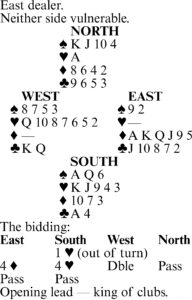
Bridge by Steve Becker
Tuesday evening TV listings
Tuesday evening TV listings
TO YOUR GOOD HEALTH: Be patient at visits to your doctor
DEAR DR. ROACH: I had several abdominal surgeries decades ago. Now that I’m approaching 70, I cannot seem to lose ...
HINTS FROM HELOISE: Be patient at visits to your doctor
DEAR HELOISE: I’ve learned that patience really matters at the doctor’s office. Sometimes I’m taken in right ...
DEAR ANNIE: Use grace to deal with a controlling relative
DEAR ANNIE: I never imagined that after raising three children, loving them through every stage and being a ...