
Heaths and heathers: What’s the difference?
Trending
This past fall, my husband and I traveled to Iceland and throughout Scandinavia.
And as I do on all our trips, I kept my eyes open for local plantings in containers and gardens. In doing so, I was not too surprised to discover that plantings in other countries can be very different from what we are familiar with here. That, of course, is determined by climate and what their native plants might be.
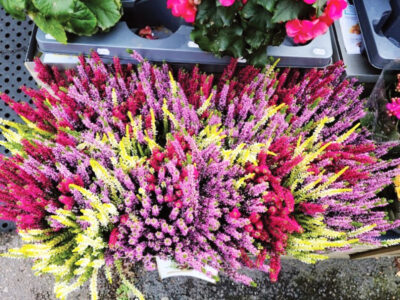
In Scandinavia, the containers and beds were full of heaths and heathers, which are flowering evergreens.
They are also native to the British Isles (think Scottish moors), western Asia, parts of Africa, and according to the Washington State University, thrive as ground covers in the Pacific Northwest.
I could identify the plant, but I needed to do some research to learn more about them.
Both heaths, genus Erica, and heathers, genus Calluna, belong to the family Ericaceae along with rhododendrons, mountain laurels and blueberries.
Heaths can grow to an average height of up to 12 inches and are said to have "teeth" because of short foliage that resembles conifer needles. Heathers are taller and can grow up to 30 inches and have flat, fan-like foliage or "feathers." The foliage of different cultivars can show a wide variety of colors.
Heaths bloom in the spring, April to June. The flowers may be white, purplish-red or pink and are urn-shaped. They produce their flower buds in the fall, and during a mild winter, might bloom then rather than wait for spring.
The flowers of heathers are single or double and bell-shaped in shades of red, pink, purple or white. Many begin to bloom in August and can last until a killing frost. A light pruning is best done in early spring, below the finished flowers and above the foliage
Heaths and heathers prefer a location that receives at least six hours of sun. Although hardy to zone five, they prefer temperate winter weather and moist and cool conditions in summer.
The root systems of both plants are shallow and easily damaged. New plantings should not be allowed to dry out. The University of Connecticut recommends growing them in soil that drains well, is low in fertility, high in organic matter and slightly acidic. Peat moss has commonly been used to help lower soil pH.
Similar results also can be achieved by using materials such as aged compost or leaf mold, along with annual applications of fertilizers formulated for acid-loving plants to help maintain suitable growing conditions.
Traveling has broadened my gardening horizons, but I think I will stick with Ohio's hardy, easy-to-grow natives!
For more information, visit https://www.mun.ca/botanical garden/media/production/
memorial/administrative/
botanical-garden/media-library/learn/heathers.pdf