
Vienna resident kills wild boar
Others worry about animals that may be on former hunting preserve
Trending
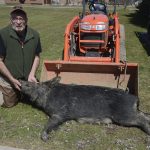
VIENNA -- Sam Guranino shot a 200-pound wild boar that was roaming around a neighbor's property Tuesday night.
Now, Guranino and other residents are expressing concern about the number of invasive animals that may be on the former Candywood Whitetail Ranch and around the township. Guranino said he has seen wild boars on and around his property for about two years.
Because something has been damaging area properties, Guranino set up cameras. They caught images of the wild boars as they moved through the area.
Guranino and a neighbor, Roy Pratt, set up a station to watch for the animals this week and shot one of two they saw coming out from the edge of the woods about 8:30 p.m. on the first night.
"It was the smaller of two boars," he said.
Pratt is concerned because boars eat plants in gardens by using their tusks to dig up the soft roots.
"That's beside the fact they're big scary animals," Pratt said. "Especially where there are a lot of kids."
Pratt estimates the larger boar may have been as heavy as 350 pounds.
"I was surprised by its size and speed," Pratt said.
Wild boars are not animals typically seen in northeastern Ohio, according to Vienna police Chief Bob Ludt. "They are not natural to this area."
Ludt said it is legal for residents to shoot wild boars. Rules for hunting wild boars, also known as feral pigs, are not regulated by the Ohio Department of Natural Resources, but by the United States Department of Agriculture Wildlife Services.
The pigs are dangerous because they don't have food preferences and adapt to pretty much wherever they live.
The U.S. spends an average of $1.5 billion per year controlling their spread and cleaning up the crops they damage, according to a USDA website.
Township Trustee Phil Pegg said the wild boars may have come from the now closed Candywood Whitetail Ranch, which, according to court records, had several hundred pigs on the property.
Candywood opened in 2015 and was a place where hunters paid to shoot anything from elk, deer, bison, boar and more inside its fenced-in property.
"The animals were supposed to have been eliminated a month ago," Pegg said. "We do not know if they all were."
Pegg said the fencing around the 275-acre property was taken down last week.
"What is happening now is what we were afraid of when they began talking about making the former golf course into a hunting ranch," Pegg said. "This is why the county asked for Candywood not to open, but were overrode by the state. We were told we did not have standing."
Pegg is confident the boars being seen now either came from Candywood or are descendents of animals that were at Candywood.
Andrew Montoney, Ohio director for USDA Wildlife Services, said feral swine have been a problem in Ohio, but not as large of a problem as they are in many southern states.
"The state does not have an accurate count of the feral pig population," Montoney said. "It has a relatively small population of feral pigs. They are not usually found in Trumbull County."
"We know a female can reproduce twice a year and have four to eight piglets each time," Montoney said. "The population can grow quickly."
A USDA official arrived on Pratt's property Wednesday afternoon and took DNA samples from the pig's ear.
Montoney said they have to make sure the animal did not carry any number of diseases.
Guranino said USDA officials are expected to set up traps in the area to catch other wild boars that may still be in the area.